Friday, April 21, 2006

More on Equiangular Triangles

In today's blog, I review more proofs on equiangular triangles that are taken straight from Euclid's Elements. I use these properties in showing that the ratio of circumference to diameter for any circle is always the same (which is, of course, the definition of pi).

Lemma 1: If two triangles have one angle equal to one angle and the sides around the equal angle proportional, then the two triangles are equiangular.


Proof:

(1) Assume that ∠ BAC ≅ ∠ EDF and BA/AC = ED/DF

(2) There exists a point G such that ∠ FDG ≅ ∠ BAC and ∠ DFG ≅ ∠ ACB [See here for details on the construction.]

(3) ∠ B ≅ ∠ G [since the angles of a triangle add up to 180 degrees, see Lemma 4 here for details]

(4) triangle ABC is equiangular with triangle DGF [from step #2 and step #3]

(5) From the properties of equiangular triangles (see here), we know that:

BA/AC = GD/DF

(6) From our assumption in Step #1, we can conclude that:

GD/DF = ED/DF

(7) And from step #6, we can conclude that:

ED ≅ GD

(8) From Step #1 and Step #2, we can conclude that:

∠ EDF ≅ FDG

(9) We can now conclude that triangle DEF ≅ triangle DGF from Side-Angle-Side (see Postulate 1 here) since:

(a) DF ≅ DF

(b) ∠ EDF ≅ ∠ FDG [Step #8]

(c) ED ≅ GD [Step #7]

(10) ∠ ACB ≅ ∠ DFE since:

(a) ∠ ACB ≅ ∠ DFG [Step #2]

(b) ∠ DFG ≅ ∠ DFE [From Step #9, see here for properties of congruent triangles if needed]

(11) Finally, we can conclude that triangle ABC is equiangular with triangle DEF since:

(a) ∠ BAC ≅ ∠ EDF [By assumption in Step #1]

(b) ∠ ACB ≅ ∠ DFE [By Step #10]

(c) ∠ B ≅ ∠ E [Since angles of triangles add up to 180 degrees]

QED

Lemma 2: Those triangles which have one angle equal to one angle and which the sides about the equal angles are reciprocally proportional, are equal.


Proof:

(1) Let the sides of triangle ABC and triangle ADE be reciprocally proportional so that:

AE/AB = CA/AD

(2) Since triangle ABC and triangle ABD share the same height, we can conclude that (see here):

AC/AD = area triangle ABC/area triangle ABD

(3) Likewise, since triangle ADE and triangle ABD share the same height, we can conclude that:

AE/AB = area triangle ADE/triangle ABD

(4) Therefore, triangle ABC/triangle ABD = triangle ADE/triangle ABD.

(5) But then we have:

area triangle ABC * area triangle ABD = area triangle ADE * area triangle ABD

(6) And if we divide both sides by the area of triangle ABD, we get:

area triangle ABC = area triangle ADE.

QED

Lemma 3: Similar triangles are one to another in the square ratio of corresponding sides.


Proof:

(1) Let triangle ABC and triangle DEF be equiangular triangles such that:

∠ A ≅ ∠ D
∠ B ≅ ∠ E
∠ C ≅ ∠ F

(2) There exists a point G such that BG = [(EF)*(EF)]/BC

(3) From (#2) we have:

1/BG = BC/[(EF)*(EF)]

which implies that:

EF/BG = BC/EF

(4) From a Property of Equiangular Triangles (see here if needed), we know that:

AB/BC = DE/EF

so that:

AB/DE = BC/EF

(5) We can also conclude that triangle ABG has equal area to triangle DEF since:

(a) B ≅ ∠ E (step #1)

(b) AB/DE = EF/BG (from combining step #3 with step #4)

(c) Lemma 2 above

(6) We can also conclude that BC/BG = (CB)2/(EF)2 since:

BC*BG = EF*EF (step #2)

And if we multiply BC to both sides, we get:

(BC)2*BG = (EF)2*BC

If we divide BG from both sides and (EF)2 from both sides, we get:

(BC)2/(EF)2 = BC/BG

(7) Since triangle ABC and triangle ABG have the same height, we can conclude (see here):

CB/BG = area triangle ABC/area triangle ABG

(8) Applying setp #6, gives us:

area triangle ABC/area triangle ABG = (BC)2/(EF)2

(9) Finally, from step #5, we have:

area triangle ABC/area triangle DEF = (CB)2/(EF)2

QED

References

Wednesday, April 19, 2006

derivate-of-sine-and-cosine

This page is incorrect. The correct page is here.

Euclid and pi

Pi, also know as Archimede's constant, is not mentioned in Euclid's Elements. The closest that Euclid comes is Proposition II in Book XII which states that two circles are to each other as the squares of their diameters.

Postulate 1: Law of Trichotomy

For any two values x,y, there are only three possible states:
(a) x = y
(b) x is less than y
(c) x is greater than y

This is one of the postulates of real numbers. See here for details on constructing real numbers.

Lemma 1: Similar polygons inscribed in circles are to one another as the squares on their diameters


Proof:

(1) By assumption, polygon ABCDE is similar to polygon FGHKL with BM and GN being the diameters of circles.

(2) From the property of similar polygon (see definition above), we have:

∠ BAE ≅ ∠ GFL

BA/AE = GF/GL

(3) triangle ABE is equiangular to triangle FGL [See Lemma 1 here for details]

(4) Since they are equiangular, we know that:

∠ AEB ≅ ∠ FLG

(5) Since both angles open on the same length of the circumference (see here):

∠ AEB ≅ ∠ AMB
∠ FLG ≅ ∠ FNG

(6) From (4) and (5), we can conclude that:

∠ AMB ≅ ∠ FNG

(7) Since BM and GN are both diameters of the circle (see here),
we can conclude that both ∠ BAM and ∠ GFN are right angles.

(8) Since the angles of a triangle add up to 180 degrees (see Lemma 4 here), we can conclude from step #6 and step #7 that triangle ABM is equiangular to triangle FGN.

(9) From the properties of equiangular triangles (see Lemma 3 here), we know that:
BM/GN = BA/GF

(10) From (9), we can conclude that:
(BM/GN)2 = (BA/GF)2 = BM2/GN2 = BA2/GF2

(11) From similar polygons (See Theorem here), we know that:
(Area of ABCDE)/(Area of FGHKL) = BA2/GF2

(12) Putting this all together, gives us:
BM2/GN2 = (Area of ABCDE)/(Area of FGHKL)

QED

Lemma 2: if A/B = C/D with A greater than C, then D is less than B.

Proof:

(1) Let A/B = C/D with A greater than C.

(2) So that AD = BC

(3) Now, D ≠ B since if D = B, then AD is greater than BC which contradicts step #2.

(4) Now, D cannot be greater than B since then AD is greater than BC which contradicts step #2.

(5) So, by the Law of Trichotomy (see Postulate above), we can conclude that D is less than B.

QED


Theorem: Two circles are to each other as the squares of their diameters.


Proof:

(1) Let C1 be the circle formed with diameter BD and area A1.

(2) Let C2 be the circle formed with diameter FH and area A2.

(3) Assume that A1/A2 ≠ (BD)2/(FH)2

(4) There exists an area S such that: (BD)2/(FH)2 = A1/S

(5) Assume that S is less than A2

(6) Then, there exists a polygon EKFLGMHN such that the area of this polygon is greater than the area of S. [From the Method of Exhaustion, see Lemma 2.]

(7) We can inscribe a similar polygon into circle C1 [See here for details on this construction]

(8) From Lemma 1 above, we can conclude:

BD2/FH2 = (Area polygon AOBPCQDR)/(Area polygon EKFLGMHN)

(9) But then, from step #4:

BD2/FH2= A1/S

(10) So we can conclude that:

(Area polygon AOBPCQDR)/(Area polygon EKFLGMNH) = A1/S

(11) Since A1 is greater than Area polygon AOBPCQDR, we can conclude from step #15 that S is greater than Area polygon EKFLGMN from Lemma 3 above.

(12) But this is impossible since in step #6 we showed that S is less than this same regular polygon so we have a contradiction and we reject our assumption in step #5.

(13) Now, let's assume that S is greater than A2

(14) So this means that (FH)2/(BD)2 = S/A1

(15) Let T be the area such that S/A1 = A2/T

(16) We can see that T is less than A1 from Lemma 2 above.

(17) There exists a regular polygon that is greater in area than T but smaller than the area of the circle by the Method of Exhaustion (see Lemma 2)

(18) We can inscribe a similar polygon in A2.

(19) From Lemma 1 above, we can conclude:

FH2/BD2 = (Area polygon EKFLGMHN)/(Area polygon AOBPCQDR)

(20) Likewise from step #14, we have:
(FH)2/(BD)2 = S/A1

(21) And from step #15, this means that:

(Area polygon EKFLGMNH)/(Area polygon AOBPCQDR) = A2/T

(22) Now A2 is greater in area than polygon EKFLGMNH so that T must be greater than the area of polygon AOBPCQDR

(23) But this is impossible from step #17 so we have a contradiction and we reject step #13.

(29) We now apply the Law of Trichotomy (see Postulate above) and we are done.

QED

References

Monday, April 17, 2006

Derivative of sine and cosine

In today's blog, I bring together some of the results that I presented earlier to determine the derivative for sine and cosine.

Lemma 1: sin(A+B) - sin(A - B) = 2*cos(A)sin(B)

Proof:

(1) sin(A+B) = cos(B)*sin(A) + cos(A)*sin(B) [See here for proof]

(2) sin(A-B) = sin(A+(-B)) = cos(-B)*sin(A) + cos(A)*sin(-B) =

(3) since cos(-B) = cos(B) [See here] and sin(-B) = -sin(B) [See here], we get:

sin(A-B) = cos(B)*sin(A) - cos(A)*sin(B)

(4) sin(A+B) - sin(A-B) =

= cos(B)*sin(A) + cos(A)*sin(B) - cos(B)*sin(A) + cos(A)*sin(B) =


= 2*cos(A)*sin(B)

QED

Lemma 2: sin P - sin Q = 2*cos [(P+Q)/2 ] * sin[(P-Q)/2]

Proof:

(1) Let A = (P+Q)/2

(2) Let B = (P-Q)/2

(3) A+B = (P+Q)/2 + (P-Q)/2 = (P+P+Q-Q)/2 = P

(4) A - B = (P+Q)/2 - (P-Q)/2 = (P-P+Q+Q)/2 = Q

(5) sin(P) - sin(Q) = sin(A+B) - sin(A-B) = 2*cos(A)*sin(B) [See Lemma 1 above]

(6) Putting it all together gives us:

sin(P) - sin(Q) = 2*cos(A)*sin(B) = 2*cos[(P+Q)/2]*sin[(P-Q)/2]

QED

Theorem 1: d/dx(sin x) = cos x

Proof:

(1) Let y = sin(x)

(2) dy/dx = lim (Δx → 0) [sin(x + Δx) - sin(x)]/Δx

(3) From Lemma 2 above we know that:
sin(x+Δx) - sin(x) = 2*cos[(x+Δx+x)/2]*sin[(x+Δx-x)/2] =
= 2*cos(x + Δx/2)*sin(Δx/2)

(4) So, substituting (3) into (2) gives us:

dy/dx = lim(Δx → 0) [ 2*cos(x+Δx/2)*sin(Δx/2) ]

(5) Using the Product Law (see here), we know that:

lim(Δx → 0) [ 2*cos(x+Δx/2)*sin(Δx/2) ] =
lim(Δx → 0)[cos(x+Δx/2)] * lim(Δx → 0)[sin(Δx/2)/(Δx/2)]

(6) Now, if we set θ = Δx/2, we know that:
lim (θ → 0) [ sin(θ)/θ ] = 1 (See here for proof)

(7) We also know that
lim(Δx → 0)[cos(x + Δx/2)] = cos x

(8) This then gives us:
dy/dx = cos x * 1 = cos x.

QED

Lemma 3: cos(A+B) - cos(A-B) = -2*sin(A)sin(B)

Proof:

(1) cos(A+B) = cos(A)*cos(B) - sin(A)*sin(B) [See here for proof]

(2) cos(A-B) = cos(A+(-B)) = cos(A)*cos(-B)-sin(A)*sin(-B)

(3) Since cos(-B) = cos(B) and sin(-B) = -sin(B) [See here], we have:

cos(A-B) = cos(A)*cos(B)+sin(A)*sin(B)

(4) cos(A+B) - cos(A-B) =

=cos(A)*cos(B) - sin(A)*sin(B) - cos(A)*cos(B) - sin(A)*sin(B) =


= -2*sin(A)*sin(B)


QED

Lemma 4: cos P - cos Q = -2*sin[(P+Q)/2]*sin[(P-Q)/2]

Proof:

(1) Let A = (P+Q)/2

(2) Let B = (P-Q)/2

(3) A + B = (P+Q)/2 + (P-Q)/2 = (P+Q+P-Q)/2 = P

(4) A - B = (P+Q)/2 - (P-Q)/2 = (P + Q - P + Q)/2 = Q

(5) cos(P) - cos(Q) = cos(A+B) - cos(A-B) = -2*sin(A)*sin(B) [From Lemma 3 above]

(6) So,

cos(P) - cos(Q) = -2*sin(A)*sin(B) = -2*sin[(P+Q)/2]*sin[(P-Q)/2]

QED

Theorem 2: d/dx(cos x) = -sin x

Proof:

(1) Let y = cos(x)

(2) dy/dx = lim(Δx → 0) [ cos(x + Δ x) - cos(x) ]/Δx

(3) Now, from Lemma 4 above:

cos(x +Δx) - cos(x) = -2*sin[(x + Δx + x)/2]*sin[(x+Δx-x)/2] =
= -2*sin(x + Δx/2)*sin(Δx/2)

(4) Once again, applying the Product Rule for limits gives us:

dy/dx = lim(Δx → 0) [ cos(x + Δ x) - cos(x) ]/Δx =
lim(Δx → 0)[ -sin(x + Δx/2) ] * lim(Δx → 0) [ sin (Δx/2)/(Δx/2)]

(5) Again, setting θ = Δx/2 gives us:
lim(Δx → 0)[ sin(θ)/θ ] = 1 [See here for proof]

(6) We can also see that:
lim(Δx → 0)[ -sin(x + Δ x/2) ] = -sin(x)

(7) Putting this all together gives us:
dy/dx = -sin(x)*1 = -sin(x)

QED

limit (θ → 0) sin θ/θ = 1

Today's proof is part of the review of basic properties that I use to determine the derivatives of sine x and cosine x. This is part of the larger story where I show how the Taylor Series can be used to define sin and cosine independently of Euclid.

To be clear, I am using Euclidean Geometry to determine the derivative for sin x and cosine x, then I am using the Taylor Series to show that these results are equivalent to an infinite series that makes no such assumption. These ideas form the foundation of Euler's Identity which is one of the most amazing results in all of mathematics.

Lemma 1: if (a/b) is greater than (c/d), then d/c is greater than b/a

Proof:

(1) Let n be a positive value such that 10n that is greater than (a/b).

(2) 10n / (c/d) is greater than 10n/(a/b) since any number can be divided more times by a smaller amount.

(3) But now, if we divide both sides of the equation by 10n, we get:

1/(c/d) is greater than 1/(a/b)

which means that:

d/c is greater than b/a

QED

Lemma 2: lim(θ → 0) sin θ/θ = 1


Proof:

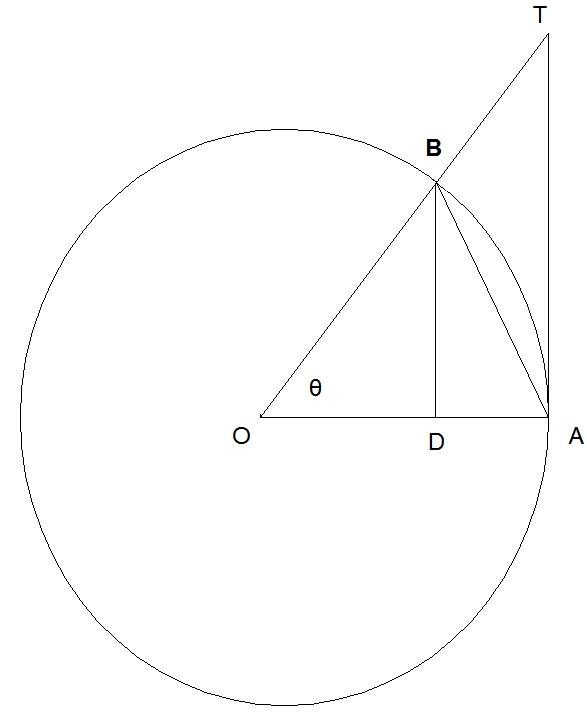
(1) Let r be the length of the radius of circle O.

(2) The area for triangle OAB = (1/2)r*(r*sin θ) [See here for details if needed]

= (1/2)r2*sin(θ)

(3) The area of the sector OAB = (1/2)r2θ [Proof to be added later]

(4) The area of the triangle OAT = (1/2)r2tan(θ)

[Since the area of a triangle is (1/2)base*height, see here if needed, with base = r and height = r*tan(θ), see here if needed]

Now, since tan(θ) = sin(θ)/cos(θ) [see here if needed], then we have:

The area of triangle OAT = (1/2)r2(sin θ)/(cos θ)

(5) So, we can see that:

area of triangle OAB is less than area of the sector OAB which is less than area of the triangle OAT.

So that:

(1/2)r2(sin θ) is less than (1/2)r2θ which is less than (1/2)r2(sin θ)/(cos θ)

(6) Dividing all sides by (1/2)r2 gives us:

sin θ is less than θ which is less than sin(θ)/cos(θ)

(7) Now, if we divide (5) by sin θ (assuming sin θ ≠ 0), then we get:

1 is less than θ/(sin θ) which is less than 1/cos(θ)

Taking the reciprocal for each value gives us:

1 is greater than (sin θ/θ) which is greater than cos(θ).

(8) Now, we know that the limit (θ → 0) 1 = 1, by the Constant Law (see here).

(9) We know that lim(θ → 0) cos(θ) = 1 since:

(a) cos θ is a continuous function (see here if more details are needed)

(b) so this means lim (θ → 0) cos θ = cos 0 = 1 (see here for definition of continuous functions, see here for review of why cos 0 = 1)

(10) But now, we can apply the Squeeze Rule (see here), to get:

lim (θ → 0) (sin θ/θ) = 1.

QED

Sunday, April 09, 2006

sin(a+b) and cos(a+b)

In today's blog, I plan to go over a basic property of sine and cosine that I will use later to find the derivatives of sine and cosine.

This is part of the larger story of using Taylor Series to come up with an equation for sine and cosine that does not depend on Euclid.

Lemma 1: Area of a triangle = (1/2)(ab)(sin C)


Proof:

Case I: C is less than 90 degrees.

(1) Let AD be perpendicular to BC

(2) We know that the area of triangle ABC is (1/2)ah (where a = the length of BC) [See here for details if needed]

(3) Now, we also know that:

sin C = h/b [Definition of sine, see here]

So that:

h = b sin C

(4) This gives us:

Area of triangle ABC = (1/2)ab*sin C [By substituting (#3) for (#2)]

Case II: C = 90 degrees

(1) Sine 90 degrees = 1 (see here for details if needed)

(2) In this case, b = h.

(3) So, the area is (1/2)ah = (1/2)ab = (1/2)ab sin 90 degrees = (1/2)ab sin C

Case III: C is greater than 90 degrees


(1) Let AD be perpendicular to BC so that B,C,D are colinear.

(2) We know that the area of triangle ABC is (1/2)ah (where a = the length of BC) [See here for details if needed]

(3) Now, we also know that:

sin C = h/b [Definition of sine, see here; since sin C = sin (180 - C).

So that:

h = b sin C

(4) This gives us:

Area of triangle ABC = (1/2)ab*sin C [By substituting (#3) for (#2)]

QED

Theorem 1: sin(a+b) = cosBsinA + cosAsinB


Proof:

(1) Let QN be a line that is perpendicular with PR.

(2) The area of triangle PQR = area of triangle PQN + area of triangle RQN

(3) By Lemma 1 above, we have:

Area of triangle PQR = (1/2)rp*sin(A+B)

Area of triangle PQN = (1/2)rh*sin(A)

Area of triangle RQN = (1/2)ph*sin(B)

(4) Combing step #2 with step #3 gives us:

(1/2)rp*sin(A+B) = (1/2)rh*sin(A) + (1/2)ph*sin(B)

(5) Multiplying 2 to both sides gives us:

rp*sin(A+B) = rh*sin(A) + ph*sin(B)

(6) Dividing both sides by rp gives us:

sin(A+B) = (h/p)*sin(A) + (h/r)*sin(B)

(7) Since QN is perpendicular to PR, we also know that (see here for definition of cosine):

cos B = h/p

cos A = h/r

(8) So that we have:

sin(A+B) = cos(B)*sin(A) + cos(A)sin(B)

QED

Lemma 2: Law of Cosines

c2 = a2 + b2 - 2ab*cos c

Proof:

Case I: Obtuse Angle (a triangle with one angle greater than 90 degrees)


(1) Let C be the obtuse angle (by C, I mean ∠ ACB)

(2) Let d = a + e

(3) Using Pythagorean Theorem (see here):

c2 = d2 + h2
b2 = e2 + h2

(4) So, we have:

c2 = (a+e)2 + h2 = a2 + 2ae + e2 + h2 =
= a2 + 2ae + b2

(5) Now, cos C = -cos(180-C) = -e/b [See here for details if needed]

So, we also have that:

e = -b*(cos C)

(6) Combining step #5 with step #6 gives us:

c2 = a2 + b2 - 2ab*(cos C).

Case II: Right triangle

In this case, the Pythagorean Theorem applies and we have:

c2 = a2 + b2

Now cos 90 degrees = 0 (see here if needed), so we also have:

c2 = a2 + b2 - 2ab*(cos C)

Case III: Acute triangle


(1) Let c be the acute angle.

(2) We will need to consider two cases. One where B is an acute angle and one where B is an obtuse angle.

(3) Let h be the height of the triangle.

(4) Let e represent the segment CD.

(5) Using Pythagorean Theorem, we have:

c2 = d2 + h2

b2 = e2 + h2

(6) Let a represent the segment BC.

(7) We see that in both cases,

d2 = (e-a)2 since:

(a) For the first triangle, a = d + e which implies -d = e - a.

(b) For the second triangle, e = d + a which implies d = e - a.

(8) And from this, we have:

d2 = e2 - 2ae + a2

which gives us:

d2 - e2 = a2 - 2ae

(9) From step #5, we have:

h2 = b2 - e2

So we also have:

c2 = d2 + h2 = d2 + b2 - e2 =
= a2 - 2ae + b2

(10) Now, cos C = e/b [See here for definition of cosine]

So we have: e = b cos C

And this then gives us:

c2 = a2 + b2 - 2ab(cos C)

QED


Theorem 2: cos(A+B) = cosA*cosB - sinA*sinB

NOTE: I will use the same diagram as I used for Theorem 1

Proof:

(1) (x+y)2 = r2 + p2 - 2rpcos(A+B) [See Law of Cosines above]

(2) If we substract (x+y)2 from both sides and add 2rp*cos(A+B) to both sides, we get:

2rp*cos(A+B) = r2 + p2 - (x+y)2 =

= r2 + p2 -x2 - 2xy - y2 =

= (r2 - x2) + (p2 - y2) - 2xy

(3) From the Pythagorean Theorem (see here), we get:

r2 = h2 + x2

and

p2 = h2 + y2

so that:

h2 = r2 - x2

and

h2 = p2 - y2

(4) Combining the results of step #3 with step #2 gives us:

2rp*cos(A+B) = r2 + p2 - (x+y)2 =(h2 + x2) + (h2 + y2) + 2xy - x2 - y2 = 2h2 - 2xy

(5) Dividing both sides by 2*rp gives us;

cos(A+B) = h2/(rp) - (xy)/(rp)

(6) Now from the definitions of sine and cosine (see here), we have:

cos A = h/r

cos B = h/p

sin A = x/r

sin B = y/p

(7) Combinining step #6 with step #5 gives us:

cos (A+B) = cosA*cosB - sinA*sinB

QED

References

Sunday, April 02, 2006

Trigonometric functions do not depend on Euclid

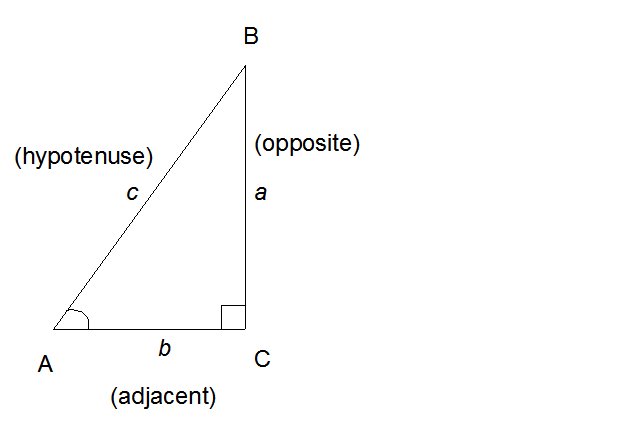
The trigonometric functions are usually taught as ratios between the sides of a right triangle. For example, given the following right triangle:


sin A = opposite/hypotenuse = a/c

cos A = adjacent/hypotenuse = b/c

tan A = opposite/adjacent = a/b

We also note that:

sin A/cos A = (opposite/hypotenuse)/(adjacent/hypotenuse) = (a/c)*(c/b) = a/b = tan A

The important idea here is that regardless of the size of the right triangle, for the same angle, the ratio between the sides is the same. This follows directly from Euclid's theorem on equiangular triangles (see here). For those interested in the history of the terms of trigonometry (see here).

Unfortunately, defining sine and cosine by right triangles does not help us for angles greater than 90 degrees or for negative values. By convention, the definitions of sine and cosine have been generalized using a unit circle definition (that is, a circle where the radius is equal to 1 unit). This works out because at all angles of the circle, it is possible to generate a unique right angle (see here for demonstration).

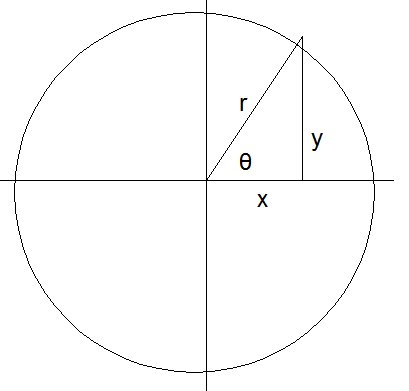
Consider a circle which has the radius r = 1.


We now define sine and cosine such that:

sin θ = y/r

cos θ = x/r

Where θ is between 0 and 90 degrees, this forms a right triangle and gives values consistent with the right triangle definitions above. This unit circle definition has the following additional properties:

Property 1: sin(0 degrees) = 0 and sin(180 degrees) = 0


Since at 0 degrees and at 180 degrees, y = 0.

Property 2: sin 90 degrees = 1

Since at 90 degrees, y = r.

Property 3: if θ is greater than 90 degrees and θ is less than 180 degrees, sin θ = sin(180 - θ)

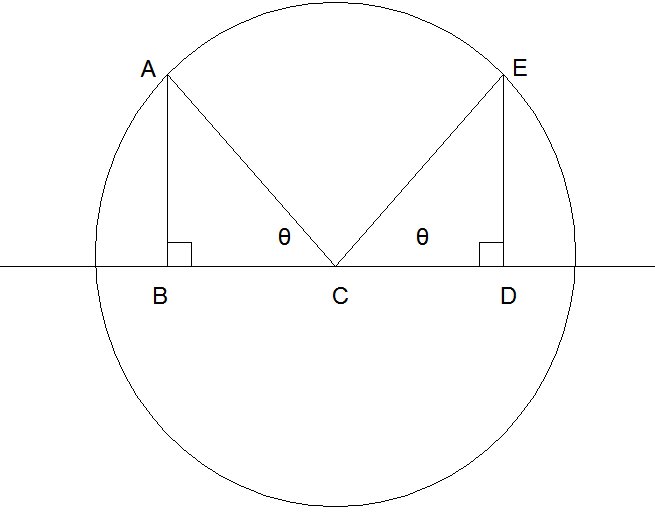
Since sin is a ratio of y/r (independent of x) and since 180 - θ forms a symmetrical angle with the same value of y. See below for proof:

Proof:

(1) We can see that triangle ABC ≅ to triangle EDC by Angle-Angle-Side (see here) since: θ ≅ θ, AC and EC are both radii of unit length, and ∠ ABC and ∠ EDC are right angles.

(2) So therefore AB ≅ ED which shows that y is the same for ∠ θ and ∠ 180 - θ .

QED

Property 4: sin (-θ) = -sin θ

For a negative value of θ, y has a negative value but is otherwise symmetrical with the positive value. See below for proof:


Proof:

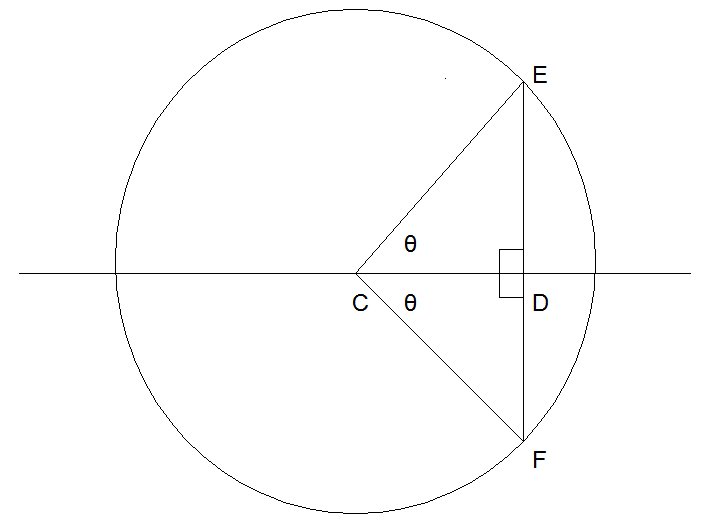
(1) We can see that triangle CED ≅ CFD by Angle-Angle-Side (see here) since CF, CE are radii of 1 unit, ∠ EDC and FDC are right angles; θ ≅ θ.

(2) So, we can see that ED ≅ DF even if DF represents a negative value of y and ED represents a positive value of y.

QED

Property 5: sin (θ + 360 degrees) = sin θ and cos(θ + 360 degrees) = cos θ

This is clear since we are using a circle as our definition and a circle consists of 360 degrees. This follows directly from our postulate of a line as having 180 degrees (see here).

Proof:

(1) Divide an circle in half with a straight line (for example, see the figure above).

(2) All the angles along the top of the line will add up to 180 degrees and likewise all the angles along the bottom will add up to 180 degrees since a straight line totals 180 degrees. (see here)

(3) Since a circle consists of the sum of top angles and the bottom angles, we can see that a circle consists of 360 degrees.

QED

Property 6: cos(0 degrees) = 1 and cos(180 degrees) = -1

This is true since at 0 degrees, x = r and at 180 degrees, -x = r.

Property 7: cos 90 degrees = 0

This is true since at 90 degrees, x = 0.

Property 8: if θ is greater than 90 degrees and less than 180 degrees, then cos θ = -cos (180 - θ)

This is true since in these cases x is negative and has a value symmetrical with the 180 - θ . This is the same as the proof for Property 3 above. It is negative since even though BC ≅ CD, BC corresponds to a negative value of x while CD corresponds to a positive value of x.

QED

Property 9: cos (-θ) = cos θ

This is true since in both the positive and negative θ cases, x still has the same value and cos is independent of y. This is the same proof as Property 4. From this proof we see that both angles involve the same positive value of x as represented by CD.

QED

It is the unit circle definition which gives us the familiar graph of sine and cosine waves (see here for details on how the unit circle provides this graph):


This is all well and good but they rely on Euclidean geometry. It turns out that using the Taylor Series (see here) from calculus, it is possible to derive an equation for sine and cosine which are independent of any assumptions from Euclid. Here they are:


tan x = sin x/cos x

For those interested in understanding how the Taylor Series can be used to derive these equations, see here.

It turns out that with these equations, we arrive at one of the most astounding equations in all of mathematics, Euler's Formula (see here):

eix = cosx + isinx

I talk more about this equation in the context of Fermat's Last Theorem here.

References:

Thursday, March 30, 2006

History of Trigonometric Terms

Trigonometry means the study of trigons (triangles). The term was first used by Bartholomew Pitiscus in 1595. If anyone is not familiar with the definitions for sine, cosine, or tangent, go to the "Right Triangle Definitions" here.

Trigonometry itself emerged from astronomy. The Babylonians, for example, showed evidence of using trigonometric functions and it is from them that we have the concept of a circle consisting of 360 degrees.

The first known person to publish a table of trigonometric functions was the Greek mathematician Hipparchus around 140 B.C. Hipparchus used these functions to calculate the size of chords in a circle from a given angle. Today, Hipparchus is known as the father of trigonometry.

All of Hipparchus's major works have been lost. Most of our information about Hipparchus comes from Claudius Ptolemy. Ptolemy's work, the Almagest, stands one of history's most influential books. Almagest was not its original name. Almagest comes the Arab translation "al-majisti" which means the greatest. It presents an earth-centered universe (from Aristotle) where planetary orbits can be understood through trigonometic functions.

The first use of the sine function comes around 500 AD in the Hindu work Aryabhata. It includes a table of half chords which are called jya. This half chord table is referenced by Brahmagupta in 628 and Bhaskara in 1150.

The Arab mathematicians used the word "jiba" and "jaib" to refer to the half chord table from the Aryabhata. The term "jaib" is Arabic for "fold". So, when the Europeans began to translate the Arab texts, they used the term "sinus" (which is Latin for "fold") as the name of the half chord table. Fibonacci, for example, used the term "sinus rectus arcus". The term "cosinus" was introduced by Edmund Gunter in 1620.

The concept of tangents was well known at the time of Thales and was associated with the measurement of shadows. The first known table of tangents (referred to as the table of shadows) was presented by an Arab mathematician in 860. The term tangent itself was first used by Thomas Finke in 1583. The term cotangent was first used by Gunter in 1620.

The secant and cosecant were not used in tables until the 15th century. Copernicus for example used the concept of the secant which he called hypotenusa.

References

Wednesday, March 29, 2006

Equiangular Triangles

In today's blog, I am reviewing the background to the concepts of sin and cosin. The major assumption behind sin and cosin is that the ratios of the sides of right triangles can be calculated based solely on the measurement of an angle. In other words, the ratio between sides ( opposite side over hypotenuse for sin and adjacent side over hypotenuse for cosin) is constant for all similar right triangles.

Two right triangles are similar if they share the same angles but not may not share the same sides. The important idea that is presented in Euclid's Elements is that the ratio of two sides is equal to the ratio of two corresponding sides for any equiangular triangle. This property of similar triangles is enough to show that sin and cosin depend solely on the measurement of the angle. I will talk more about this in a future blog.

I will only go over enough which are necessary to establish the corresponding sides property of similar triangles.

Lemma 1: If two triangles have the same height, then the ratio of their areas is equal to a ratio of their bases.


Proof:

(1) Let a1 be the area of triangle ABC with height h and base b1

(2) Let a2 be the area of triangle DEF with height h and base b2

(3) Now a1/a2 = [(1/2)b1h]/[(1/2)b2h] = b1/b2 [See Lemma 2, here]


QED

Lemma 2: If a parallel line cuts through a triangle, it divides the sides of the triangle proportionally.


Proof:

(1) Let DE be a parallel line that cuts through the triangle ABC

(2) We can see that the areas of triangle DEB and triangle DEC are equal since:

(a) They share the same base DE

(b) They have the same height [Based on Lemma 2, here]

(3) Since triangle DEB and triangle DEC have the same area, we know that:

(area DEB)/(area ADE) = (area DEC)/(area ADE)

(4) Now triangle DEB and triangle ADE have the same height.

(5) So, we also know that from Lemma 1 above:
(area DEB)/(area ADE) = DB/AD

(6) Likewise, triangle AED and triangle DEC have the same height so Lemma 1 gives us:
(area DEC)/(area ADE) = EC/AE

(7) Putting this all together (steps #3, #5, and #6) gives us:
DB/AD = EC/AE

QED

Postulate 1: Parallel Postulate

If two lines intersect the same line and the sum of their intersectings angles is less than 180 degrees, these lines will eventually intersect.

For more details on the Parallel Postulate, see here. This is the most famous postulate of all Euclid's Elements.

Lemma 3: If two triangles are equiangular, then the sides about equal angles are proportional where the corresponding sides are opposite the equal angles.


Proof:

(1) Let ABC and DCE be equiangular triangles.

(2) Let us assume that BC and CE are colinear.

(3) Since ∠ ABC ≅ ∠ DCE, we know that FB is parallel to DC [See here for definition of parallel lines]

(4) Since ∠ BCA ≅ ∠ CED, we know that AC is parallel to FE [See here for definition of parallel lines]

(5) By the Parallel Postulate above, we know that if we extend line AB and line DE, they will intersect at a point F.

(6) Now, from (3) and (4), ACDF is a parallelogram [See here for definition of a parallelogram]

(7) Therefore FA ≅ DC and AC ≅ FD [See Lemma 1 here]

(8) Since AC is a parallel line that cuts through triangle FBE, Lemma 2 above gives us:
BA/AF = BC/CE

which means that

BA * CE = BC * AF

and further that:

BA/BC = AF/CE

(9) Since AF ≅ DC [from #7], we have
BA/BC = DC/CE

(10) Since DC is a parallel line that also cuts through triangle FBE, we get:
BC/CE = FD/DE

(11) Now combining (#7) and (#9), we get:
BC/CE = FD/DE = AC/DE

which means that:

BC * DE = AC * CE

and further that:

BC/AC = CE/DE

(12) Combining (#11) and (#9) gives us:

BA/BC = DC/CE [from #9]
BC/AC = CE/DE [from #11]

So that we have:

BA*CE = BC*DC
BC*DE = AC*CE

And we have:

BA*CE*BC*DE = BC*DC*AC*CE

So that we can divide out CE and BC to get:

BA*DE = AC*DC

And finally that:

BA/AC = DC/DE

(13) So we are done since we have:
BA/BC = DC/CE [Step #9]
BC/AC = CE/DE [Step #11]
BA/AC = DC/DE [Step #12]

QED

References

Tuesday, March 28, 2006

Area of Triangles

In today's blog, I present some very elementary proofs regarding area. This is needed by the proofs on similar triangles which I use as background for sin and cosin.

I present these definitions and proofs more for a sense of completeness.

Definition 1: Rectangle

A rectangle is a parallelogram where all angles are 90 degrees.

Definition 2: Area of a rectangle

The area of a rectangle is width * height.

Definition 3: Right Triangle

A right triangle is triangle where one of its angles is 90 degrees.

Lemma 1: The area of a parallelogram is base * height


Proof:

This follows directly from Lemma 2, here since we can construct a rectangle in the same parallel based on the base of the parallelogram.

By Lemma 2, the parallelogram will be congruent to this rectangle so the area of the parallelogram will be the same.

QED

Lemma 2: The area of any triangle is (1/2)height * base


Proof:

(1) Let ABC be a triangle

(2) Let CE be a line parallel to AB

(3) Let AF be a line parallel to BC

(4) let D be the point where CE and AF intersect.

(5) From (2) and (3), we see that ABCD is a parallelogram. [See here for definition of a parallelogram]

(6) Then triangle ABC ≅ triangle CDA by S-A-S since [See here for definition of S-A-S]:

(a) AB ≅ CD and BC ≅ DA since opposite sides of a parallelogram are congruent [See here for proof]

(b) ∠ ABC ≅ ∠ CDA since opposite angles of a parallelogram are congruent [See here for proof]

(7) Now since the area of the parallelogram is itself is base*height (see Lemma 1 above), the area of each triangle is (1/2)base*height.

QED

References

Thursday, March 23, 2006

Parallelograms

In today's blog, I review some basic proofs from Euclid's Elements relating to Parallelograms. These extend the results on parallel lines and are needed for the proofs on similar triangles which I use in my discussion about sin and cosin.

The diagrams are taken from David Joyce's web site on Euclid's Elements which I highly recommend.

Definition: Parallelogram

A parallelogram is any four-sided shape where opposite sides are parallel to each other.


Lemma 1: In parallelograms, opposite sides and opposite angles are congruent.


Proof:

(1) Let ABCD be a parallelogram.

(2) AD is parallel to BC [Definition of Parallelogram]

(3) Alternate angles are congruent [see Lemma 2 here] gives us:
∠ DAC ≅ ∠ BCA
∠ DCA ≅ ∠ BAC

(4) Since line AC is congruent to itself, we can use the ASA lemma (see here) to conclude that triangle DAC ≅ triangle BCA

(5) But then corresponding sides are congruent which gives us (see here for definition of Congruent Triangles):
BC ≅ AD
AB ≅ DC

(6) And opposite angles are congruent since:
∠ ADC ≅ ∠ CBA [see here for definition of Congruent Triangles]

We can assume that ∠ DAB ≅ ∠ DCB since we could apply the same arguments #1 thru #6 to the diagonal DB as well.

QED

Lemma 2: Parallelograms on the same base and in the same parallel are equal to each other.


Proof:

(1) Let ABCD and EBCF be parallograms that share the same base BC and are colinear on AF.

(2) AD ≅ EF since:

AD ≅ BC [Since they are opposite sides of ABCD from Lemma 1 above]
EF ≅ BC [Since they are opposite sides of EBCF from Lemma 1 above]

(3) AE ≅ DF since:

AE = AD + DE
DF = EF + DE

AD ≅ EF (from the previous step)

(4) Now we can use Postulate 1 to conclude triangle ABE ≅ triangle DCF since:

AB ≅ DC [Since they are opposite sides of ABCD, from Lemma 1 above]

AE ≅ DF [Step #3]

∠ EAB ≅ ∠ FDC [since AB is parallel to DC and since Corresponding angles are congruent for parallel lines -- see here]

(5) We note that the trapezoid ABGD has the same area as EGCF since:

Both are formed from subtracting the area of DGE.

(6) But this implies that that the parallelogram ABCD is congruent to EBCF since they both formed by adding GBC to each trapezoid above.

QED

Lemma 3: Triangles with equal bases in the same parallels are equal to each other.

If ABC, DEF are triangles with BC ≅ EF; if AD is parallel to BF; and if C,E lie on BF; then, ABC ≅ DEF.


Proof:

(1) Let G be a point colinear with AD such that BG is parallel to AC.

(2) Let H be a point colinear with AD such that FH is parallel to DE.

(3) Then GACB and DHFE are parallelograms [Definition of parallelograms]

(4) Then the area of GACB is equal to the area of DHFE [See Lemma 2 above]

(5) The area of triangle ABC is half the area of GACB; and the area of triangle DEF is half the area of DHFE since:

(a) From Lemma 1 above, we know that each triangle such as DEF is congruent to its other half (in the case of DEF its other half is FHD)

(b) But if both triangles are congruent, then each triangle is (1/2) the total area, that is, the area of each triangle is half the area of each parallelogram.

(6) Since GACB ≅ DHFE (#4), we have (in terms of areas):
ABC = (1/2)GACB
DEF = (1/2)GACB

So we can see that ABC ≅ DEF.

QED

Corollary 3.1: If a parallelogram has the same base with a triangle and is in the same parallels, then the parallelogram is double the triangle.


Proof:

(1) Let ABCD be a parallelogram

(2) Triangle ABC ≅ triangle EBC from Lemma 3 above.

(3) And triangle ABC ≅ triangle CDA by Side-Angle-Side (see here) since:

(a) AD ≅ BC (By Lemma 1 above)

(b) DC ≅ AB (By Lemma 1 above)

(c) ∠ ADC ≅ ABC (By Lemma 1 above)

(4) Since triangle ABC ≅ triangle ECB ≅ triangle CDA is follows that parallelogram ABCD is double the area of triangle ECB.

QED

References