Wednesday, March 29, 2006

Equiangular Triangles

In today's blog, I am reviewing the background to the concepts of sin and cosin. The major assumption behind sin and cosin is that the ratios of the sides of right triangles can be calculated based solely on the measurement of an angle. In other words, the ratio between sides ( opposite side over hypotenuse for sin and adjacent side over hypotenuse for cosin) is constant for all similar right triangles.

Two right triangles are similar if they share the same angles but not may not share the same sides. The important idea that is presented in Euclid's Elements is that the ratio of two sides is equal to the ratio of two corresponding sides for any equiangular triangle. This property of similar triangles is enough to show that sin and cosin depend solely on the measurement of the angle. I will talk more about this in a future blog.

I will only go over enough which are necessary to establish the corresponding sides property of similar triangles.

Lemma 1: If two triangles have the same height, then the ratio of their areas is equal to a ratio of their bases.


Proof:

(1) Let a1 be the area of triangle ABC with height h and base b1

(2) Let a2 be the area of triangle DEF with height h and base b2

(3) Now a1/a2 = [(1/2)b1h]/[(1/2)b2h] = b1/b2 [See Lemma 2, here]


QED

Lemma 2: If a parallel line cuts through a triangle, it divides the sides of the triangle proportionally.


Proof:

(1) Let DE be a parallel line that cuts through the triangle ABC

(2) We can see that the areas of triangle DEB and triangle DEC are equal since:

(a) They share the same base DE

(b) They have the same height [Based on Lemma 2, here]

(3) Since triangle DEB and triangle DEC have the same area, we know that:

(area DEB)/(area ADE) = (area DEC)/(area ADE)

(4) Now triangle DEB and triangle ADE have the same height.

(5) So, we also know that from Lemma 1 above:
(area DEB)/(area ADE) = DB/AD

(6) Likewise, triangle AED and triangle DEC have the same height so Lemma 1 gives us:
(area DEC)/(area ADE) = EC/AE

(7) Putting this all together (steps #3, #5, and #6) gives us:
DB/AD = EC/AE

QED

Postulate 1: Parallel Postulate

If two lines intersect the same line and the sum of their intersectings angles is less than 180 degrees, these lines will eventually intersect.

For more details on the Parallel Postulate, see here. This is the most famous postulate of all Euclid's Elements.

Lemma 3: If two triangles are equiangular, then the sides about equal angles are proportional where the corresponding sides are opposite the equal angles.


Proof:

(1) Let ABC and DCE be equiangular triangles.

(2) Let us assume that BC and CE are colinear.

(3) Since ∠ ABC ≅ ∠ DCE, we know that FB is parallel to DC [See here for definition of parallel lines]

(4) Since ∠ BCA ≅ ∠ CED, we know that AC is parallel to FE [See here for definition of parallel lines]

(5) By the Parallel Postulate above, we know that if we extend line AB and line DE, they will intersect at a point F.

(6) Now, from (3) and (4), ACDF is a parallelogram [See here for definition of a parallelogram]

(7) Therefore FA ≅ DC and AC ≅ FD [See Lemma 1 here]

(8) Since AC is a parallel line that cuts through triangle FBE, Lemma 2 above gives us:
BA/AF = BC/CE

which means that

BA * CE = BC * AF

and further that:

BA/BC = AF/CE

(9) Since AF ≅ DC [from #7], we have
BA/BC = DC/CE

(10) Since DC is a parallel line that also cuts through triangle FBE, we get:
BC/CE = FD/DE

(11) Now combining (#7) and (#9), we get:
BC/CE = FD/DE = AC/DE

which means that:

BC * DE = AC * CE

and further that:

BC/AC = CE/DE

(12) Combining (#11) and (#9) gives us:

BA/BC = DC/CE [from #9]
BC/AC = CE/DE [from #11]

So that we have:

BA*CE = BC*DC
BC*DE = AC*CE

And we have:

BA*CE*BC*DE = BC*DC*AC*CE

So that we can divide out CE and BC to get:

BA*DE = AC*DC

And finally that:

BA/AC = DC/DE

(13) So we are done since we have:
BA/BC = DC/CE [Step #9]
BC/AC = CE/DE [Step #11]
BA/AC = DC/DE [Step #12]

QED

References

Tuesday, March 28, 2006

Area of Triangles

In today's blog, I present some very elementary proofs regarding area. This is needed by the proofs on similar triangles which I use as background for sin and cosin.

I present these definitions and proofs more for a sense of completeness.

Definition 1: Rectangle

A rectangle is a parallelogram where all angles are 90 degrees.

Definition 2: Area of a rectangle

The area of a rectangle is width * height.

Definition 3: Right Triangle

A right triangle is triangle where one of its angles is 90 degrees.

Lemma 1: The area of a parallelogram is base * height


Proof:

This follows directly from Lemma 2, here since we can construct a rectangle in the same parallel based on the base of the parallelogram.

By Lemma 2, the parallelogram will be congruent to this rectangle so the area of the parallelogram will be the same.

QED

Lemma 2: The area of any triangle is (1/2)height * base


Proof:

(1) Let ABC be a triangle

(2) Let CE be a line parallel to AB

(3) Let AF be a line parallel to BC

(4) let D be the point where CE and AF intersect.

(5) From (2) and (3), we see that ABCD is a parallelogram. [See here for definition of a parallelogram]

(6) Then triangle ABC ≅ triangle CDA by S-A-S since [See here for definition of S-A-S]:

(a) AB ≅ CD and BC ≅ DA since opposite sides of a parallelogram are congruent [See here for proof]

(b) ∠ ABC ≅ ∠ CDA since opposite angles of a parallelogram are congruent [See here for proof]

(7) Now since the area of the parallelogram is itself is base*height (see Lemma 1 above), the area of each triangle is (1/2)base*height.

QED

References

Thursday, March 23, 2006

Parallelograms

In today's blog, I review some basic proofs from Euclid's Elements relating to Parallelograms. These extend the results on parallel lines and are needed for the proofs on similar triangles which I use in my discussion about sin and cosin.

The diagrams are taken from David Joyce's web site on Euclid's Elements which I highly recommend.

Definition: Parallelogram

A parallelogram is any four-sided shape where opposite sides are parallel to each other.


Lemma 1: In parallelograms, opposite sides and opposite angles are congruent.


Proof:

(1) Let ABCD be a parallelogram.

(2) AD is parallel to BC [Definition of Parallelogram]

(3) Alternate angles are congruent [see Lemma 2 here] gives us:
∠ DAC ≅ ∠ BCA
∠ DCA ≅ ∠ BAC

(4) Since line AC is congruent to itself, we can use the ASA lemma (see here) to conclude that triangle DAC ≅ triangle BCA

(5) But then corresponding sides are congruent which gives us (see here for definition of Congruent Triangles):
BC ≅ AD
AB ≅ DC

(6) And opposite angles are congruent since:
∠ ADC ≅ ∠ CBA [see here for definition of Congruent Triangles]

We can assume that ∠ DAB ≅ ∠ DCB since we could apply the same arguments #1 thru #6 to the diagonal DB as well.

QED

Lemma 2: Parallelograms on the same base and in the same parallel are equal to each other.


Proof:

(1) Let ABCD and EBCF be parallograms that share the same base BC and are colinear on AF.

(2) AD ≅ EF since:

AD ≅ BC [Since they are opposite sides of ABCD from Lemma 1 above]
EF ≅ BC [Since they are opposite sides of EBCF from Lemma 1 above]

(3) AE ≅ DF since:

AE = AD + DE
DF = EF + DE

AD ≅ EF (from the previous step)

(4) Now we can use Postulate 1 to conclude triangle ABE ≅ triangle DCF since:

AB ≅ DC [Since they are opposite sides of ABCD, from Lemma 1 above]

AE ≅ DF [Step #3]

∠ EAB ≅ ∠ FDC [since AB is parallel to DC and since Corresponding angles are congruent for parallel lines -- see here]

(5) We note that the trapezoid ABGD has the same area as EGCF since:

Both are formed from subtracting the area of DGE.

(6) But this implies that that the parallelogram ABCD is congruent to EBCF since they both formed by adding GBC to each trapezoid above.

QED

Lemma 3: Triangles with equal bases in the same parallels are equal to each other.

If ABC, DEF are triangles with BC ≅ EF; if AD is parallel to BF; and if C,E lie on BF; then, ABC ≅ DEF.


Proof:

(1) Let G be a point colinear with AD such that BG is parallel to AC.

(2) Let H be a point colinear with AD such that FH is parallel to DE.

(3) Then GACB and DHFE are parallelograms [Definition of parallelograms]

(4) Then the area of GACB is equal to the area of DHFE [See Lemma 2 above]

(5) The area of triangle ABC is half the area of GACB; and the area of triangle DEF is half the area of DHFE since:

(a) From Lemma 1 above, we know that each triangle such as DEF is congruent to its other half (in the case of DEF its other half is FHD)

(b) But if both triangles are congruent, then each triangle is (1/2) the total area, that is, the area of each triangle is half the area of each parallelogram.

(6) Since GACB ≅ DHFE (#4), we have (in terms of areas):
ABC = (1/2)GACB
DEF = (1/2)GACB

So we can see that ABC ≅ DEF.

QED

Corollary 3.1: If a parallelogram has the same base with a triangle and is in the same parallels, then the parallelogram is double the triangle.


Proof:

(1) Let ABCD be a parallelogram

(2) Triangle ABC ≅ triangle EBC from Lemma 3 above.

(3) And triangle ABC ≅ triangle CDA by Side-Angle-Side (see here) since:

(a) AD ≅ BC (By Lemma 1 above)

(b) DC ≅ AB (By Lemma 1 above)

(c) ∠ ADC ≅ ABC (By Lemma 1 above)

(4) Since triangle ABC ≅ triangle ECB ≅ triangle CDA is follows that parallelogram ABCD is double the area of triangle ECB.

QED

References

Wednesday, March 22, 2006

Congruent Triangles

In today's blog, I review congruent triangles. These are all based on Euclid's Elements. If you would like to review Euclid's classic works, I strongly recommend David Joyce's web site on Euclid's Elements.

The site presents the complete Elements with proofs, definitions, and axioms and includes commentaries. All of the applets on this page are taken from David's web site.

Definition 1: Congruent Triangles

Two triangles are said to be congruent if corresponding angles are congruent and corresponding sides are congruent.

Postulate 1: Congruent by Side-Angle-Side (SAS)

For any two triangles, if two corresponding sides are congruent and the angle in between is congruent, then the triangles are congruent.


In the example below, if AB ≅ DE and BC ≅ EF and ∠ ABC ≅ ∠ DEF; then triangle ABC ≅ triangle DEF.


Euclid originally presented this as a proof using the method of superposition in his Elements (see here). The rigorousness of this method has been questioned. For these reasons, I am presenting this as a postulate. For those interested in more details, see here.

Postulate 2: Congruent by Side-Side-Side (SSS)

For any two triangles, if all 3 corresponding sides are congruent, then the triangles are congruent.

Euclid provides a proof of this one also using the method of superposition. For my purposes, I am presenting it as a postulate. For Euclid's proof, see here.

Lemma 1: For any two triangles, if two corresponding angles are congruent and the sides in between those angles are congruent, then the triangles are congruent.
If ∠ ABC ≅ ∠ DEF and BC ≅ EF and ∠ BCA ≅ EFD, then triangle ABC ≅ triangle DEF


Proof:

(1) Assume that AB is not congruent to DE

(2) Since they are not congruent, either AB or DE is bigger. We will assume it is AB (if it were DE we could still use the same argument)

(3) Then there exists a point G on AB such that BG ≅ DE

(4) By our assumption, we have ∠ ABC ≅ ∠ DEF and we have BC ≅ EF

(5) So, then we have triangle GBC ≅ triangle DEF [By Postulate 1 above]

(6) But then ∠ BCG ≅ ∠ EFD since corresponding angles of congruent triangles are congruent.

(7) But this is impossible since ∠ BCA ≅ &EFD and ∠ BCA is clearly not equal to ∠ BCG.

(8) Since we have a contradiction we reject our assumption at (1) and conclude that AB ≅ DE

(9) But now we have triangle ABC ≅ triangle DEF by Postulate 1 above since:

AB ≅ DE [By Step #8]

∠ ABC ≅ ∠ DEF [By the given]

BC ≅ EF [By the given]

QED

Corollary 1.1: For two triangles, if any two angles are congruent and any side is congruent, then both triangles are congruent.

(1) Let us assume that we have the pattern AAS (angle-angle-side) or SAA (side-angle-angle) congruent for the two triangles.

If we have ASA, then we know they are congruent by Lemma 1.

(2) But then we know that all corresponding angles of both triangles are congruent since:

Let a,b,c be the three angles of the first triangle. Let a',b',c' be the three angles for the second triangle.

Let's suppose that a,b match so that a' = a, b' = b.

Now, we know that a+b+c = 180 and a' + b' + c' = 180 [See Lemma 4 here]

So c = 180 - a - b

Also c' = 180 - a' - b' = 180 - a - b

So we see that c = c'

(3) And (#2) means that AAS and SAA imply ASA (angle-side-angle) which implies congruence by Lemma 1 above.

QED

References

Thursday, March 16, 2006

Parallel Lines

In today's blog, I review some basic ideas of parallel lines. I will later use these proofs to establish the basic properties of sin and cosin functions.

Postulate 1: The angles of a straight line add up to 180 degrees.

Lemma 1: Vertical angles are congruent

Let AB and EF be two lines that intersect at E.


Then:

∠ EGB ≅ ∠ AGF

Proof:

(1) ∠ EGB + ∠ EGA = 180 degrees. [Postulate 2]

(2) ∠ EGA + ∠ AGF = 180 degrees.

(3) So ∠ EGB = 180 - ∠ EGA and ∠ AGF = 180 - ∠ EGA

(4) So, ∠ EGB ≅ ∠ AGF.

QED

Lemma 2: If any corresponding angles of an intersected line are congruent, then all corresponding angles are congruent.


Proof:

(1) We start with ∠ EGA ≅ ∠ EHC

(2) Using Postulate 1, we know that ∠ EGB ≅ ∠ EHD since:
∠ EGA + ∠ EGB = 180 so that ∠ EGB = 180 - ∠ EGA
∠ EHC + ∠ EHD = 180 so that ∠ EHD = 180 - ∠ EHC

(3) Using Lemma 1, we get:
∠ FGA ≅ ∠ FHC since:
∠ FGA ≅ ∠ EGB and ∠ FHC ≅ ∠ EHD

∠ FGB ≅ ∠ FHD since:
∠ FGB ≅ ∠ EGA and ∠ FHD ≅ ∠ EHC

QED

Since any one corresponding angle implies the rest, we can use this as a definition for parallel lines.

Definition 1: Two lines are parallel if any and only if the corresponding angles of an intersecting line are congruent.

In the case of the example above, lines AB and CD are parallel if we can prove any of the following true:
(a) ∠ EGB ≅ ∠ EHD
(b) ∠ EGA ≅ ∠ EHC
(c) ∠ FHC ≅ ∠ FGA
(d) ∠ FHD ≅ ∠ FGB

Postulate 2: From any point not on a line, it is possible to construct a line that intersects the point and is parallel to the other line.

Lemma 3: Alternate angles of parallel lines are congruent


Proof:

(1) ∠ AGF ≅ ∠ CHF [From Definition of Parallel Lines]

(2) ∠ CHF ≅ ∠ EHD [From Lemma 1: Verical Angles]

(3) ∠AGF ≅ ∠ EHD

QED

Lemma 4: The angles of a triangle add up to 180 degrees


Proof:

(1) Let EC be a line that is parallel AB [Postulate 2]

(2) ∠ ECA ≅ ∠ BAC [Lemma 3, Alternating angles of parallel lines]

(3) ∠ ECD ≅ ∠ ABC [Lemma 2, Corresponding angles of parallel lines]

(4) Now ∠ ACB + ∠ ECA + ∠ ECD = 180 degrees [Postulate 1]

(5) So ∠ ABC + ∠ BAC + ∠ ACB = 180 degrees too.

QED

References

Tuesday, March 14, 2006

Derivative of e

In today's blog, I will show the proof for the derivative of e and derivative of the natural logarithm.

Lemma 1: d/dx(ln x) = 1/x

Proof:

(1) d/dx(ln x) = lim (Δx → 0) (ln (x + Δ x) - ln x)/Δ x =
= lim (Δx → 0)(ln([x + Δx]/x)/Δ x [From the basic properties of logarithms, see here]

= lim(Δx → 0) (1/Δ x)(ln([x + Δx]/x) =

= lim (Δx → 0) (ln[([x + Δx]/x)(1/Δx)])

= lim(Δx → 0) (ln[(1 + Δx/x)(1/Δx)])

(2) Let u = Δx/x

(3) lim(Δx → 0) (ln[(1 + Δx/x)(1/Δx)]) =
= lim (u → 0)(ln[(1 + u)(1/[ux])]) =
= lim(u → 0)([1/x][ln(1 + u)(1/u)])

(4) Now lim(u → 0) (1 + u)(1/u) =
= lim(u → inf)(1 + 1/u)u since:

(a) lim (u → inf)(1/u) = lim(u → 0)(u)

(b) lim (u → inf)(u) = lim (u → 0)(1/u)

(5) Now, (#4) is the definition of Euler's Number (see here), so we have:
lim(u → inf)(1 + 1/u)(u) = e

which means that:

lim(u → 0)(1 + u)(1/u) = e

(6) Putting (#5) in (#3) gives us:

lim(u → 0)([1/x][ln(1 + u)(1/u)]) =
= (1/x)ln(e) = (1/x)(1) [Since ln e = 1, see here for definition of ln ]

QED

Lemma 2: (d/dx)ex = ex

Proof:

(1) Set u = ex

(2) Using the chain rule we have:
(d/dx) ln u = (d/du)ln u * (d/dx)(ex)

(3) From lemma 1, we know that:
(d/du)ln u = (1/u)

(4) We also know that:
(d/dx)(ln(ex)) = (d/dx)(x) = 1

(5) So from #2, we get:
(d/du)ln u * (d/x)(ex) = (1/u)(d/x)(ex) = 1

(6) Or simply:
(1/u)(d/x)(ex) = 1

(7) Multiplying u to both sides gives us:
(d/x)(ex) = u

(8) But u = ex, so we get:
(d/x)(ex) = ex

QED

References:

Monday, March 13, 2006

Logarithms

Each elementary mathematical operation has an inverse operation that has the ability to cancel it. Subtraction and addition are inverses as are multiplication and division. From one perspective, n-roots are the inverse operation to exponents. If xn = y, then x = n√y.

So that the inverse operation becomes:

n√xn = x.

But what about the value n? Can we do an operation on n which cancels out x? The answer is yes, with logarithms.

In logarithms, we say that logx y = n. So from this perspective, a logarithm is an inverse of the power operation in the sense that:

xlogx y = y

This concept of logarithms and methods for deriving them were first popularized in the west by John Napier in 1614. Historically, logarithms were handled using logarithm tables. For those interested in the history of logarithms and logarithm tables, Wikipedia has an excellent article here.

One of the most important logarithm functions in loge which is written as ln. This turns out to have very important mathematical properties such as:

∫(1/x)dx = ln x

Here are some very basic properties of logarithms that I use in other proofs:

Lemma 1: logx a + logx b = logx (ab)

Proof:

(1) Let a,b be any two real, nonzero numbers.

(2) Let a' = logx a so that a = x(a')

(3) Let b' = logx b so that b = x(b')

(4) Now x(a')*x(b') = x(a' + b') [See here for review of exponents if needed]

(5) So (ab) = x(a' + b') [From #4]

(6) So logx (ab) = a' + b' = logx a + logx b

QED

Lemma 2: logx a - logx b = logx (a/b)

Proof:

(1) Let a,b be any two real, nonzero numbers.

(2) Let a' = logx a so that a = x(a')

(3) Let b' = logx b so that b = x(b')

(4) Now x(a')/x(b') = x(a' - b') [See here for review of exponents if needed]

(5) So (a/b) = x(a' - b') [From #4]

(6) So logx (a/b) = a' - b' = logx a - logx b

QED

Lemma 3: b*logx a = logx (ab)

Proof:

(1) Let a,b be any two real, nonzero numbers.

(2) b*logx a = logx a + ... + logx a [So that we have b items to add together]

(3) From (#2) and Lemma 1 above, we have
b*logx a = logx a + ... + logx a = logx (a*a*...*a)

(4) Since we have b multiples of a, we get:
b*logx a = logx (ab)

QED

References

Sunday, March 12, 2006

Euler's Number

In 1683, Jacob Bernoulli was working on a problem with regard to compound interest. In calculating compound interest, the formula comes down to (1 + 1/n)n. Bernoulli noticed that this equation had a limit between 2 and 3 as n got larger and larger.

Today, we would state the definition for Euler's Number in the following way:


so that:

e = 2.7182...

This value is called Euler's Number after Leonhard Euler. Euler refered to the constant as "e" in 1727. He was not the first to discover the constant but he published so many important mathematical works relating to e that it became known as Euler's Number. Interestingly, it is believed that Euler chose "e" not because it was the first letter of his last name but because he wanted to use a vowel and he had already used "a".

Here is a graph of ex:


References

Generalized Power Rule

In today's blog, I continue review of the basics of calculus and derivatives. Today, I will go over the Generalized Power Rule for Derivatives.

This rule can be used in the the proof for Taylor's Formula.

Lemma 1: The Root Rule

dy/dx(x(1/q)) = (1/q)x(1/q)-1

Proof:

(1) Let y = x(1/q)

(2) Then, x = yq

(3) dx/dy(yq) = qyq-1 [From the Power Rule, see here]

(4) dy/dx = 1/(dx/dy) = 1/(qyq-1)

(5) Applying (#1) to (#4) gives us:

dy/dx = 1/(q[x(1/q))q-1]) =
= (1/q)(1/[x1 - (1/q)]) =
= (1/q)(x(1/q)-1)

QED

Lemma 2: The Chain Rule

If a function f is differentiable at x and a function g is also differentiable at f(x), then if h is a function such that h(x) = g(f(x)), then h'(x) = g'(f(x))*f'(x)

Proof:

(1) Let x0 be a point where f is differentiable.

(2) Let y0=f(x0) and be a point where g is differentiable.

(3) Let k(Δx) = f(x0 + Δx) - f(x0) where Δx is nonzero and k(Δx) is nonzero.

(4) Then:

[g(f(x0 + Δx)) - g(f(x0))]/Δx =

= [[g(f(x0) + k(Δx)) - g(f(x0))]/k(Δx)]*[(k(Δx)/Δx]

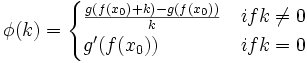
(5) Let's define a function φ such that:


(6) We can see that φ is continuous at k=0 since differentiability implies continuity (see Lemma 4 here)

(7) So, from (3), we see that:
lim (k → 0) φ(k) = g'(f(x0)).

(8) Now, lim(Δx → 0) k(Δx) = lim(Δx → 0)[f(x0 + Δx) -f(x0)] = f(x0)-f(x0) = 0

(9) Because f is continuous at x0 and because φ(0) = g'(f(x0)), we conclude from (#5):

lim (Δx → 0) φ(k(Δx)) = g'(f(x0))

(10) Applying #5 to #4 gives us
[[g(f(x0) + k(Δx)) - g(f(x0))] /k(Δx)]*[k(Δx)/Δx] = φ(k(Δx))*[k(Δx)/Δx]

(11) Applying #3 to #10 gives us
φ(k(Δx))*[k(Δx)/Δx] = φ(k(Δx))*[[f(x0 + Δx) - f(x0)]/(Δ x)]

(12) Using #4 thru #11 gives us:

lim (Δx → 0) [g(f(x0 + Δx)) - g(f(x0))]/Δ x =

= lim (Δ x → 0) φ(k(Δx))*[f(x0 + Δx) - f(x0)]/Δ x =

= g'(f(x0))*f'(x0)

QED

Corollary: if n is an integer, then D[f(x)]n = n[f(x)]n-1f'(x)

(1) Let g(u) = un where n is an integer

(2) g'(u) = nun-1 [By the Power Rule for Derivatives, see here]

(3) Now, if u = f(x), then g'(u) = g'(f(x))*f'(x) [From Chain Rule above]

(4) So, D[f(x)]n/dx = n[f(x)]n-1*f'(x) [From #2 and #3]

QED

Theorem: Generalized Power Rule

If x is differentiable at x and r is a rational number, then:
D([f(x)r])/dx = r[f(x)]r-1*f'(x)

Proof:

(1) [f(x)](p/q)] = {[f(x)]p}(1/q) = u(1/q) where p,q are positive integers and u = [f(x)]p

(2) Du/dx = p[f(x)]p-1f'(x) [From the Corollary above]

(3) D[f(x)](p/q)/dx = Du(1/q)/dx =

= (1/q)u(1/q)-1Du/dx [From the Root Rule above]

= (1/q){[f(x)]p}(1/q)-1p[f(x)]p-1f'(x) [From step # 2 above]

= (p/q)[f(x)]p((1/q)-1)+p-1f'(x)

= (p/q)[f(x)](p/q)-1f'(x)

QED

References

Saturday, March 11, 2006

Rolle's Theorem

Rolle's Theorem is one of the basic principles of elementary calculus. It is used to proof the Taylor Series which is used to prove Euler's Formula.

In today's blog, I present a proof based on the maxima and minima property of a continous function.

If you need a review of derivatives, start here.

If you need a review of continuous functions or closed intervals, start here.

If you need a review of the maxima and minima properties of continuous functions over a closed interval, start here.

Theorem: Rolle's Theorem

If a function f(x) is continuous over a closed interval [a,b], differentiable over that interval, with f(a)=0 and f(b)=0, then there exists a point c ∈ [a,b] such that f'(c) =0.

Proof:

(1) Because the function f is continuous over the closed interval [a,b], then there exists a maximum value (see Lemma 3 here) and a minimum value (see the Theorem here)

(2) If f has any positive values, then let c = its maximum value over the closed interval [a,b]

(3) Now by assumption in (2), c is not an endpoint since f(a) and f(b) =0 and we are assuming that f(c) is positive. So, we know that c ∈ [a,b]

(4) Since by (2), c is a local maximum (see clarification here for definition), we know by an earlier theorem that f'(c) = 0 (see the Theorem here).

(5) Now, if f has any negative values, then let c = its minimum value over the closed interval [a,b]

(6) Now by assumption (5), c is not an endpoint since f(a) and f(b) = 0 and we are assuming that f(c) is negative. So, we know that c ∈ [a,b]

(7) This will be a local minimum (see clarification here for definition) and we know by an earlier theorem that f'(c) = 0 (see the Corollary here).

(8) If there are no positive or negative values for the function f in [a,b], then we can take any point ∈ [a,b] and know that f(c)=0. We further know that f'(c)=0 since in this case f(x)=C (see Lemma 1 here for the Derivative of f(x)=C).

QED

Friday, March 10, 2006

Combining Continuous Functions

Continuous functions can be combined to form new, more complicated continued functions. In today's blog, I will review some basic lemmas on how functions built from continued functions are themselves continued functions. Finally, I will show how these lemmas can be used to establish the minimum property of continuous functions over a closed interval.

If you are not familiar with continuous functions, then should review here.

Lemma 1: Constant Law

f(x) = C where C is a constant is a continuous function

(1) Let δ = 1

(2) Let x,c be any two values in the domain of f(x).

(3) We know that f(x) - f(c) = C - C = 0

(4) So, it is also true, if x-c is between -δ and +δ, for any nonzero value ε, that f(x) - f(c) is between -ε and +ε [Since 0 is between -ε and +ε]

(5) So, by the definition of continuous functions (see here), f(x)=C is a continuous function.

QED

Lemma 2: Addition Law

if f(x) and g(x) are continuous functions, then f(x) + g(x) is a continuous function.

(1) Let ε be any nonzero value.

(2) Let c be any point on the domain of f(x) + g(x).

(3) Since f(x) is continuous, we know that there exists δ1 such that:
if x - c is between -δ1 and +δ1, then f(x) - f(c) is between -ε/2 and +ε/2

(4) Since g(x) is continuous, we know that there exists δ2 such that:
if x - c is between -δ2 and +δ2, then g(x) - g(c) is between -ε/2 and +ε/2

(5) Let δ = min(δ1,δ2)

(6) Now, if x - c is between -δ and +δ, then:

(a) f(x) - f(c) is between -ε/2 and +ε/2

(b) g(x) - g(c) is between - ε/2 and + ε/2

(c) f(x) + g(x) - f(c) - g(c) is between (-ε/2 + -ε/2) and (+ε/2 + +ε/2)

(7) So, f(x) + g(x) is a continous function.

QED

Lemma 3: Multiplication Law
if f(x) and g(x) are continuous functions, then f(x)*g(x) is a continuous function.

(1) Let ε be any nonzero value.

(2) Let c be any point on the domain of f(x)*g(x).

(3) Since f(x) is continuous, we know that there exists δ1 such that:
if x - c is between -δ1 and +δ1, then f(x) - f(c) is between -ε and +ε

So there exists a constant A = max(absolute[ε + f(c)], absolute[-ε + f(c)]) such that:
if x - c is between -δ1 and +δ1, then f(x) is between -A and +A.

(4) Let B = g(c).

(5) We also know that there exists δ2 such that:
if x - c is between -δ2 and +δ2, then f(x) - f(c) is between -ε/(2B) and ε/(2B).

(6) And there exists δ3 such that:
if x - c is between -δ3 and +δ3, then g(x) - g(c) is between -ε/(2A) and ε/(2A)

(7) Let δ = min(δ1,δ2,δ3)

(8) Now, if x - c is between -δ and +δ, then:

(a) f(x) - f(c) is between -ε/(2B) and +ε/(2B)

(b) g(x) - g(c) is between - ε/(2A) and + ε/(2A)

(c) g(c)[f(x) - f(c)] is between (B)[-ε/(2B)] and (B)[+ε/(2B)] which is between -ε/2 and ε/2.

(d) f(x)[g(x) - g(c)] is between (A)[-ε/(2A)] and (A)[+ε/(2A)] which is between -ε/2 and ε/2.

(e) If we add (c) + (d), we get:
f(x)g(c) - f(c)g(c) + f(x)g(x) - f(x)g(c) = f(x)g(x) - f(c)g(c)

(f) So, f(x)g(x) - f(c)g(c) is between (-ε/2 + -ε/2) and (+ε/2 + +ε/2)

(7) So, f(x)g(x) is a continous function.

QED

Lemma 4: Differentiability implies continuity

If f is differentiable at a, then f is continuous at a

Proof:
(1) Since f is differentiable at a, there exists a value c such that f'(a) = c [See here for definition of derivative]

(2) Let ε be any nonzero value

(3) Let δ = Δx

(4) By the definition of the derivative (see here), we know that:
if x - a is between -δ and δ, then f(x) = c so that f(x) - f(c) = 0 which is between ε and -ε

(5) Therefore, by the definition of continuity at a point (see here), f(x) is continuous at point a.

QED

Theorem: Minimum Value Property of Continuous Functions

If a function f is continuous on a closed interval [a,b], then there exists a number c in [a,b] such that f(x) ≥ f(c) for all x in [a,b]

(1) We can construct a continuous function g(x) such that g(x) = (-1)f(x).

We know that g(x) is a continuous function since it is the product of a constant function h(x)=-1 and f(x). [See Lemma 1and Lemma 3 above]

(2) Now, g(x) has a maximum point on the interval [a,b] (from the Maximum Value Property of Continuous Functions, see here)

(3) But since g(x) = -f(x), this corresponds to a minimum point for f(x) since:

(a) Let c be the maximum for g(x)

(b) g(x) ≤ g(c) for all x in [a,b]

(c) But then:
-g(x) ≥ -g(c) for all x in [a,b]

(d) Which means that:
f(x) ≥ f(c) for all x in [a,b]

QED

References

Thursday, March 09, 2006

Maxima and Minima of Continuous Functions

For a given continuous function on a closed interval, if there is a point in this closed interval where the derivative of f(x) = 0, then this point is either the low point (minima) or high point (maxima) for the continuous function in this interval.

This very basic idea of calculus requires a few lemmas before we are able to prove it.

If you are not familiar with the concept of a function, continuous function, or a closed interval, start here.

A function is said to be bounded if there is a value L such that for all x ∈ [a,b], f(x) ≤ L.

Lemma 1: Nested Interval Property for the real numbers

Suppose that I1, I2, ..., In is a sequence of nested, closed intervals where:
(a) Each Ii+1 is contained with Ii
(b) Each Ii interval is of the form [ai,bi]
(c) The lim (i → inf) (bi - ai) = 0 (See here for review of lim notation and the concept of limit)
Then:
There exists 1 and only 1 point c such that {c} = I1 ∩ I2 ∩ ... ∩ In

Proof:

(1) We know that there can be at most 1 number since lim(i → inf) (bi - ai) = 0 since:

If there were more than 1 number, the lim(i → inf) (bi - ai) would be greater than 0.

The only way that it can be 0 is if bi = c, ai = c, and c-c=0.

(2) We know that there is at least 1 number that is common to all intervals since:

(a) ai has a limit an that fits somewhere in the interval. For all intervals, it is clear that ai ≤ an ≤ bi

(b) Likewise, bi has a limit bn such that ai ≤ bn ≤ bi

(c) So we see that an,bn are both elements of all intervals.

(d) We further note that an = bn since the lim(i → inf)(bi - ai)= 0.

(e) So, if we let c = an = bn, then we are done.

QED

Lemma 2: If a function f is continuous on a closed interval [a,b], then f is bounded there.

(1) Assume that a function f is not bounded on [a,b]

(2) We can bisect the interval [a,b] into two halves which I will label I1 and I2.

(3) We can now pick an interval I which is unbounded. If both intervals are unbounded, then we can pick either one.

(4) We can repeat this process and create a sequence of nested, closed intervals which we can call Ii where each interval selects a subset which is unbounded.

(5) From Lemma 1, we know that there exists a point c which is common to all the intervals in #4.

(6) Because f is continuous, we know that there is a number ε such that f is bounded on the interval c - ε and c + ε [See here for definition of Continuous Functions]

(7) But one of the unbounded values in In must lie within (c - ε, c + ε)

(8) And this is a contradiction since from (#6), it must be bounded.

(9) Therefore, we reject our assumption.

QED

Lemma 3: Maximum value property of continuous functions

If a function f is continuous on the closed interval [a,b], then there exists a number c in [a,b] such that f(x) ≤ f(c) for all x in [a,b]

(1) Let I be the the closed interval [a,b]

(2) From Lemma 2, we know that I is bounded.

(3) Let λ be its least upper bound.

(4) We can divide I in half.

(5) At least one of these halves will have a least upper bound = λ (although it is possible that both have this least upper bound). Let I1 be the division of I which contains λ as the least upper bound.

(6) We can keep dividing up I1 in the same way until we have In which has λ as its upper bound and bn - an = 0.

(7) From Lemma 1, we know that there exists a point c which is common to all these intervals.

(8) It follows from (6) that f(c)=λ since:

(a) There exists a positive value δ such that if x-c is in between -δ and +δ, then f(x)-f(c) is between -ε and ε. [From the definition of a continuous function, see here]

(b) From (a), we have that f(c) - ε is less than f(x) which is less than f(c) + ε

(c) Since ε can be arbitrarily small, we can have f(c) ≤ f(x) ≤ f(c) which means that f(x)=f(c) at some point.

(d) In this case, f(c) cannot be more than λ since λ is an upper bound. [See here for the definition of an upper bound]

(e) Likewise, f(c) cannot be less than λ since λ is the least upper bound. [See here for the definition of a least upper bound]

(f) Therefore, f(c) = λ

QED

Definition 1: Right Hand Limit: lim (x → a+) f(x)

lim (x → a+) f(x) = L if and only if:

if x is between a and a + δ, then f(x) - f(a) is between -ε and ε

Definition 2: Left Hand Limit: lim(x → a-) f(x)

lim(x → a-) f(x) = L if and only if:

if x is between a - δ and a, then f(x) - f(a) is between -ε and ε

Lemma 4: One-sided and two-sided limits

The limit lim (x → a) for f(x) exists and is equal to the number L if and only if the one-sided liimits lim (x → a+) f(x) and lim (x → a-) f(x) both exist and both are equal to the number L.

Proof:

(1) Assume lim(x → a) f(x) = L

(2) Then if x - a is between δ and - δ, then f(x) - f(a) is between -ε and +ε [ By the definition of continuous functions, see here]

(3) Now x - a is between δ and -δ implies that:
x is between a - δ and a + δ.

(4) Since a is greater than a - δ (since δ is a positive value), this implies that:
if x is between a and a + δ, then x is necessarily between a - δ and a + δ.

(5) (#4) combined with (#2) gives us:
lim (x → a+) f(x) = L. [See definition 1 above]

(6) Since a is less than a + δ, this implies that:
if x is between a - δ and a, then x is between a - δ and a + δ.

(7) (#6) combined with (#2) gives us:
lim (x → a-) f(x)= L. [See definition 2 above]

(8) So, that proves the first half of the above theorem.

(9) Assume that lim (x → a+) f(x) = L and lim(x → a-) f(x) = L

(10) From definition 1, we have if x is between a and a + δ, then f(x) - f(a) is between -ε and ε

(11) From definition 2, we have if x is between a-δ and a, then f(x) - f(a) is between -ε and ε

(12) Combining (10) and (11) gives us:
if x is between a-δ and a+δ then f(x) - f(a) is between -ε and ε [For either condition (10) applies or condition (11) applies]

(13) Then, applying the definition of limit (see here), we get:
lim(x → a) f(x) = L

QED

Clarification: Local Maxima and Minima

A maximum or minimum is local if it is true for a given interval. A maximum or minimum is absolute if it is true across a domain. A maximum is value that is greater than all other points in for the range in question. A minimum is a value that is smaller or equal to all other points in the range in question.

Theorem: Local Maxima

If a function f(x) is differentiable at c and is defined as an open interval containing c and if f(c) is a local maximum value of f(x), then f'(c)=0.

Proof:

(1) Assume that f(c) is a local maximum value for f(x) on the open interval (a,b).

(2) Since c is differentiable, it means that right-hand and left-hand limits both exist and are equal to f'(c). [See Lemma 4 above]

lim (Δx → 0+) [f(c + Δx) - f(c)]/Δx = f'(c)

lim (Δx → 0-) [f(c + Δx) - f(c)]/Δx = f'(c)

(3) If Δx is greater than 0, then:

[f(c + Δx) - f(c)]/Δ x ≤ 0

This is true since f(c) ≥ f(c +Δx) for all small positive values of Δx since f(c) is a local maximum by assumption.

(4) If Δx is less than 0, then:

[f(c + Δx) - f(c)]/Δ x ≥ 0

This is true since in this case, we have a negative value f(c + Δx) - f(c) over another negative value Δx.

(5) So, we have from (#2):
f'(c) = lim(Δx → 0+) [f(c + Δx) - f(c)]/Δ x ≤ 0

(6) But we also have from (#2):
f'(c) = lim(Δx → 0-) [f(c + Δx) - f(c)]/Δx ≥ 0

(7) Combining (#5) and (#6), we can conclude that f'(c) = 0 [since f'(c) ≥ 0 and f'(c) ≤ 0 ]

QED

Corollary: Local Minima

If a function f(x) is differentiable at c and is defined as an open interval containing c and if f(c) is a local minimum value of f(x), then f'(c)=0.

Proof:

(1) Assume that f(c) is a local minimum value for f(x) on the open interval (a,b).

(2) Since c is differentiable, it means that right-hand and left-hand limits both exist and are equal to f'(c). [See Lemma 4 above]

lim (Δx → 0+) [f(c + Δx) - f(c)]/Δx = f'(c)

lim (Δx → 0-) [f(c + Δx) - f(c)]/Δx = f'(c)

(3) If Δx is greater than 0, then:

[f(c + Δx) - f(c)]/Δ x ≥ 0

This is true since f(c) ≤ f(c +Δx) for all small positive values of Δx since f(c) is a local minimum by assumption.

(4) If Δx is less than 0, then:

[f(c + Δx) - f(c)]/Δ x ≤ 0

This is true since in this case, we have a positive value f(c + Δx) - f(c) over a negative value Δ x.

(5) So, we have from (#2):
f'(c) = lim(Δx → 0+) [f(c + Δx) - f(c)]/Δ x ≥ 0

(6) But we also have from (#2):
f'(c) = lim(Δx → 0-) [f(c + Δx) - f(c)]/Δx ≤ 0

(7) Combining (#5) and (#6), we can conclude that f'(c) = 0 [since f'(c) ≥ 0 and f'(c) ≤ 0 ]

QED

References