In today's blog, I go over the proof for Eudoxus's Method of Exhaustion. This proof is used later in Euclid's proof that the areas of circles are in proportion to the squares of their diameters.
Theorem: Method of Exhaustion
Let x,y be any two positive real numbers where x is greater than y. If we continually remove a quantity v ≥ (1/2) from x, then eventually, we will be left with a value that is smaller than y.
Proof:
(1) We will only need to prove this for v = 1/2 since:
(a) This proof is done if we can show that there exists n such that (1/2)n*x is less than y.
(b) We only need to prove it for v=1/2 since we know that if v is less than (1/2), then:
vn*x is less than (1/2)*n*x.
(2) Let m be an integer such that m ≥ x/y + 1
(3) So that ym is greater than x
(a) Since ym is greater than y(x/y + 1) = x + y
(b) and x + y is greater than x since y is nonzero.
(4) There exists a value n such that 2n is greater than m.
(a) Let m = 1
(b) 21 = 2 is greater than 1.
(c) Assume this is true up to n.
(d) So that 2n is greater than n.
(e) Since 2n is greater than 1, we know that:
2n + 2n = 2*(2n) = 2n+1 is greater than n+1.
(f) So that this is true by induction.
(5) Thus, we see that y/x is greater than 1/2n
(a) ym is greater than x (step #2)
(b) so, m is greater than x/y
(c) and 1/m is less than y/x (or in other words, y/x is greater than 1/m)
(d) Now, 2n is greater than m so 1/2n is less than 1/m which also means that it is less than y/x.
(6) Thus (1/2)nx is less than y since y/x is greater than (1/2)n means that y is greater than (1/2)n*m.
QED
Now, let's look at two applications of the Method of Exhaustion.
Lemma 1: If a square is inscribed in a circle, its area is greater than half the area of the circle.
Proof:
(1) Let EFGH be a square that is inscribed in the circle above (see here for details on this construction).
(2) Let KLMN be a square that is circumscribed around the circle above (see here for details on this construction).
(3) The area of KLMN is greater than the area of the circle.
(4) The square EFGH is equal to (1/2) the area of KLMN since:
(a) Each square KFCE, FLGC, CGMH, ECHN are (1/4) the area of KLMN.
(b) Each triangle EFC, CFG, HCG, ECH is (1/4) the area of EFGH
(c) Each triangle EFC, CFG, HCG, ECH is (1/2) the area of the corresponding square KFCE, FLGC, CGMH, ECHN.
(d) Therefore, area EFGH = (1/2) * area KLMN
(5) Finally, area EFGH = (1/2)* area KLMN which is greater than the area of (1/2) the circle (from step #3).
QED
Lemma 2: For any area A that is smaller than the area of a circle C, there exists a regular polygon P that is smaller than C but greater than A.
Proof:
(1) Let us form a circle C on the diameter FH. [See here for details on construction]
(2) It is possible to find points E,G such EFGH forms a square that is inscribed in circle C [See here for details on this construction]
(3) The area of the square EFGH is greater than (1/2) the area of circle C [See Lemma 1 above]
(4) We can constructs points K, N, M, and L so that point K is midway between points E and F, N is midway between E and H, M is midway between H and G, and L is midway between G and F. [See here for details on this construction]
(5) Each triangle EKG, FLG, GMH, and HNE is greater in area than half the segment of the circle about it since:
(a) From each triangle, we can construct a rectangle that has an area greater than the circle segment. For example, around triangle EKG we can construct a rectangle as in the diagram above.
(b) Each half of the triangle is exactly 1/4 the size of the rectangle since each point bisects the side of the circumscribed square.
(c) So the triangle EKG is equal to (1/2) the area of the rectangle.
(d) Since the area of the rectangle is greater than the area of the segment, (c) gives us that the triangle EKG is greater than (1/2) the area of the segment.
(6) We can keep repeating this step so that each time, we remove more than (1/2) the area:
(a) We select the midpoints to each of the existing segments. [See step #4 for details]
(b) We form a triangle with these new midpoints from the points of the segment that this new point bisected.
(c) This set of triangles together forms a new regular polygon.
(d) Each triangle has more area than half the circle segment that had previously remained. [This is the same as the argument in step #5]
(11) So, then there eventually exists a polygon EKFLGMHN such that the area of this polygon is greater than the area of S. [From the Method of Exhaustion above since each time we do step #6, we are subtracting greater than 1/2 of the remaining area from the circle.]
QED
Lemma 3: If a regular polygon P1 with area A1 is circumscribed around a circle C, then there exists a smaller polygon P2 with area A2 that can also be circumscribed around circle C such that:
A2 - C is less than (1/2)(A1 - C)
Proof:
(1) Let C be a circle formed from diameter BD with center E. [See here for details on construction]
(2) Circumscribe a square GHKF around circle C. [See here for details on construction]
(3) Find a point M that lies on circle C and is midway between A and B [See here for details on construction]
(4) Let ON be a line tangent to M such that N is on GA and O is on GB.
(5) ∠ GMN is a right angle [See here for details]
(6) GN is greater than MN [See the corollary here for details]
(7) MN ≅ AN since:
(a) ∠ EAN ≅ ∠ EMN since they are both right angles.
(b) AE,ME are both radii, so we have AE ≅ ME and therefore (see Theorem 1, here), ∠ EAP ≅ ∠ EMP
(c) Using subtraction of step #7b from step #7a gives us ∠ NAM ≅ ∠ NMA.
(d) And #7c gives us AN ≅ MN since congruent angles implies congruent sides (see Corollary to Theorem 1, here)
(8) So GN is greater than AN too
(9) triangle AMN and triangle GMN have the same height since they are both on the same base AG and since they share the same vertice at M.
(10) Now, we can conclude that area of GMN is greater than the area of AMN since they share the same height (step #9) but the base of GMN is greater than the base of AMN (step #8) since area = (1/2)base * height (See Lemma 2 here for details if needed)
(11) triangle GLA ≅ triangle GLB by Side-Angle-Side since:
(a) GB ≅ GA since they are the sides of the same square.
(b) ∠ BGL ≅ ∠ AGL since we can prove triangle GAE ≅ triangle GBE by Side-Side-Side.
(c) Both triangles share the same side at GL.
(12) So the area of OGN is greater than half the area of BGA.
(13) The argument in step #11 applies to each side and we can conclude that converting this polygon from a 4-sided to 8-sided regular polygon results in removing greater than (1/2) the difference between the area of the 4-sided polygon and the area of the circle.
(14) We can use the same method to divide an 8-sided polygon to a 16-sided polygon and so on.
QED
References
Sunday, April 30, 2006


Sunday, April 23, 2006
Similar Polygons
In today's blog, I present a proof from Euclid on similar polygons. I use this theorem later in my proof for the existence of pi.
Definition: Similar Polygons
Two polygons are similar if corresponding angles are congruent and corresponding sides are proportional.
Lemma 1: A/B = C/D, then (A+C)/(B+D) = A/B = C/D
Proof:
(1) Let A/B = C/D
(2) Then AD=BC and A = BC/D
(3) So,
(A+C)/(B+D) = (BC/D + C)/(B + D) = (BC/D + CD/D)/(B+D) = [(BC+CD)/D][1/(B+D)] =
= [C(B+D)]/[D(B+D)] =C/D
QED
Corollary 1.1: A/B = C/D = E/F → (A+C+E)/(B+D+F)=A/B=C/D=E/F
Proof:
(1) (A+C)/(B+D) = A/B = C/D = E/F [See Lemma 1 above]
(2) Let U = A+C, V = B+D
(3) U/V = A/B = C/D [From step #1]
(4) U+E/V+F = A/B = C/D=E/F [From Lemma 1 above]
(5) But then:
(A + C + E)/(B + D + F)
QED
Lemma 2: if A/B = C/D, then A/C = B/D
Proof:
(1) A/B = C/D
(2) A*D = B*C
(3) Dividing both sides by C*D gives us:
A/C = B/D
QED
Lemma 3: if BE/AB = GL/GF and AB/BC = GF/GH,
then: BE/BC = GL/GH
Proof:
(1) BE/AB = GL/GF → BE*GF = GL*AB
(2) AB/BC = GF/GH → AB*GH = BC*GF
(3) So that:
BE*GF*AB*GH = GL*AB*BC*GF
(4) Dividing both sides by GF*AB*BC*GH gives us:
BE/BC = GL/GH
QED
Therem 1: Similar polygons have a ratio equal to the square of the ratio of two corresponding sides.
Proof:
(1) Let ABCDE and FGHKL be similar polygons.
(2) From the properties of similar polygons (see definition above), we know that:
(a)
∠ ABC ≅ ∠ FGH
AB/BC = FG/GH
(b)
∠ BCD ≅ ∠ GHK
BC/CD = GH/HK
(c)
∠ CDE ≅ ∠ HKL
CD/DE = HK/KL
(d)
∠ DEA ≅ ∠ KLF
DE/EA = KL/LF
(e)
∠ EAB ≅ ∠ LFG
EA/AB = LF/FG
(3) From congruent angles and corresponding sides (see here), we know that:
(a) triangle ABC is equiangular with triangle FGH (from #2a)
(b) triangle BCD is equiangular with triangle GHK (from #2b)
(c) triangle ECD is equiangular with triangle LHK (from #2c)
(d) triangle ABE is equiangular with triangle FGL. (from #2e)
(4) BE/BC = GL/GH (from Lemma 3 above) since:
(a) BE/AB = GL/GF (from #3d)
(b) AB/BC = GF/GH (from #3a)
(5) ∠ EBC ≅ ∠ LGH since:
(a) ∠ ABE ≅ ∠ FGL (#3d)
(b) ∠ ABC ≅ ∠ FGH (#3a)
(c) ∠ EBC = ∠ ABC - ∠ ABE
(d) ∠ LGH = ∠ FGH - ∠ FGL = ∠ ABC - ∠ ABE
(6) triangle EBC ≅ triangle LGH (from here) since:
(a) BE/BC = GC/GH (#4)
(b) ∠ EBC ≅ ∠ LGH (#5)
(7) triangle BOC is equiangular with triangle GPH since:
(a) ∠ OBC ≅ ∠ PGH (from #3b)
(b) ∠ BCO ≅ ∠ GHP (from #6)
(8) From the properties equiangular triangles we know that:
(a) ∠ BAM ≅ ∠ GFN (#3a)
(b) ∠ ABM ≅ ∠ FGN (#3d)
(c) ∠ MBC ≅ ∠ NGH (#6)
(d) ∠ BCM ≅ ∠ GHN (#3a)
(e) ∠ ODC ≅ ∠ PKH (#3b)
(f) ∠ OCD ≅ ∠ PHK (#3c)
(9) From congruent angles and corresponding sides again (see here), we know that:
(a) triangle AMB equiangular with triangle FNG from ∠ BAM ≅ ∠ GFN (#7a) and ∠ ABM ≅ ∠ FGN (#7b)
(b) triangle BMC equiangular with triangle GNH from ∠ MBC ≅ ∠ NGH (#7c) and ∠ BCM ≅ ∠ GHN (#7d)
(c) triangle COD equiangular with triangle HPK from ∠ ODC ≅ ∠ PKH (#7e) and ∠ OCD ≅ ∠ PHK (#7f).
(9) From properties of equiangular triangles, we know that:
(a) CO/OD = HP/PK (from #8c)
(b) BO/OC = GP/PH (from #7)
(c) AM/MB = FN/NG (from #8a)
(d) BM/MC = GN/NH (from #8b)
(10) Using Lemma 3 above gives us:
(a) BO/OD = GP/PK (from #9b and #9a)
(b) AM/MC = FN/NH (from #9c and #9d)
(11) Since triangles with the same height have their areas proportional to their bases (see here), we know that:
(a) BO/OD = BOC/COD
(b) BO/OD = BOE/OED
(c) GP/PK = GPH/HPK
(d) GP/PK = LGP/LPK
(e) AM/MC = ABM/MBC
(f) AM/MC = AME/EMC
(g) FN/NH = FGN/NGH
(h) FN/NH = FNL/LNH
(12) From step #11, we find that:
(a) BOC/COD = BOE/EOD
(b) GPH/HPK = LGP/LPK
(c) ABM/MBC = AME/MEC
(d) FGN/NGH = FNL/LNH
(13) From Lemma 1 above, we get:
(a) ABM/MBC = ABE/CBE since [ABE/CBE = (ABM + AME)/(MBC + MEC)]
(b) FGN/NGH = FGL/HGL since [FGL/HGL = (FGN + FNL)/(NGH +LNH)]
(c) BOC/COD = CBE/CED since [CBE/CED = (BOC + BOE)/(COD + OED)]
(d) GPH/HPK = HGL/HLK since [HGL/HLK = (GPH + LGP)/(HPK + LPK)]
(14) Combining step #11 with step #13 gives us:
(a) BO/OD = CBE/CED (see #11a and #13c)
(b) GP/PK = HGL/HLK (see #11c and #13d)
(c) AM/MC = ABE/CBE (see #11e and #13a)
(d) FN/NH = FGL/HGL (see #11g and #13b)
(15) Combining step #10 with step #14 gives us:
(a) CBE/CED = HGL/HLK (see #14a, #14b and #10a)
(b) ABE/CBE = FGL/HGL (see #14c, #14d and #10b)
(16) Using step #15 and Lemma 2, we get:
(a) CBE/HGL = CED/HLK (from #15a)
(b) ABE/FGL = CBE/HGL (from #15b)
(c) Thus, CBE/HGL = CED/HLK = ABE/FGL
(17) Now, polygon ABCDE and polygon FGHKL divide up into three triangles where:
polygon ABCDE = triangle ABE + triangle CBE + triangle CED
polygon FGHKL = triangle FGL + triangle HGL + triangle HLK
(18) Using step #16, we can apply Corollary 1.1 above to get:
triangle ABE/triangle FGL = polygon ABCDE/polygon FGHKL
(19) Since similar triangles are one to another in square ratio of the corresponding sides (see here), we have (see step #3d):
triangle ABE/triangle FGL = (AB)2/(FG)2
(20) Combining step #18 with step #19 gives us:
polygon ABCDE/polygon FGHKL = (AB)2/(FG)2
QED
References
Definition: Similar Polygons
Two polygons are similar if corresponding angles are congruent and corresponding sides are proportional.
Lemma 1: A/B = C/D, then (A+C)/(B+D) = A/B = C/D
Proof:
(1) Let A/B = C/D
(2) Then AD=BC and A = BC/D
(3) So,
(A+C)/(B+D) = (BC/D + C)/(B + D) = (BC/D + CD/D)/(B+D) = [(BC+CD)/D][1/(B+D)] =
= [C(B+D)]/[D(B+D)] =C/D
QED
Corollary 1.1: A/B = C/D = E/F → (A+C+E)/(B+D+F)=A/B=C/D=E/F
Proof:
(1) (A+C)/(B+D) = A/B = C/D = E/F [See Lemma 1 above]
(2) Let U = A+C, V = B+D
(3) U/V = A/B = C/D [From step #1]
(4) U+E/V+F = A/B = C/D=E/F [From Lemma 1 above]
(5) But then:
(A + C + E)/(B + D + F)
QED
Lemma 2: if A/B = C/D, then A/C = B/D
Proof:
(1) A/B = C/D
(2) A*D = B*C
(3) Dividing both sides by C*D gives us:
A/C = B/D
QED
Lemma 3: if BE/AB = GL/GF and AB/BC = GF/GH,
then: BE/BC = GL/GH
Proof:
(1) BE/AB = GL/GF → BE*GF = GL*AB
(2) AB/BC = GF/GH → AB*GH = BC*GF
(3) So that:
BE*GF*AB*GH = GL*AB*BC*GF
(4) Dividing both sides by GF*AB*BC*GH gives us:
BE/BC = GL/GH
QED
Therem 1: Similar polygons have a ratio equal to the square of the ratio of two corresponding sides.
Proof:
(1) Let ABCDE and FGHKL be similar polygons.
(2) From the properties of similar polygons (see definition above), we know that:
(a)
∠ ABC ≅ ∠ FGH
AB/BC = FG/GH
(b)
∠ BCD ≅ ∠ GHK
BC/CD = GH/HK
(c)
∠ CDE ≅ ∠ HKL
CD/DE = HK/KL
(d)
∠ DEA ≅ ∠ KLF
DE/EA = KL/LF
(e)
∠ EAB ≅ ∠ LFG
EA/AB = LF/FG
(3) From congruent angles and corresponding sides (see here), we know that:
(a) triangle ABC is equiangular with triangle FGH (from #2a)
(b) triangle BCD is equiangular with triangle GHK (from #2b)
(c) triangle ECD is equiangular with triangle LHK (from #2c)
(d) triangle ABE is equiangular with triangle FGL. (from #2e)
(4) BE/BC = GL/GH (from Lemma 3 above) since:
(a) BE/AB = GL/GF (from #3d)
(b) AB/BC = GF/GH (from #3a)
(5) ∠ EBC ≅ ∠ LGH since:
(a) ∠ ABE ≅ ∠ FGL (#3d)
(b) ∠ ABC ≅ ∠ FGH (#3a)
(c) ∠ EBC = ∠ ABC - ∠ ABE
(d) ∠ LGH = ∠ FGH - ∠ FGL = ∠ ABC - ∠ ABE
(6) triangle EBC ≅ triangle LGH (from here) since:
(a) BE/BC = GC/GH (#4)
(b) ∠ EBC ≅ ∠ LGH (#5)
(7) triangle BOC is equiangular with triangle GPH since:
(a) ∠ OBC ≅ ∠ PGH (from #3b)
(b) ∠ BCO ≅ ∠ GHP (from #6)
(8) From the properties equiangular triangles we know that:
(a) ∠ BAM ≅ ∠ GFN (#3a)
(b) ∠ ABM ≅ ∠ FGN (#3d)
(c) ∠ MBC ≅ ∠ NGH (#6)
(d) ∠ BCM ≅ ∠ GHN (#3a)
(e) ∠ ODC ≅ ∠ PKH (#3b)
(f) ∠ OCD ≅ ∠ PHK (#3c)
(9) From congruent angles and corresponding sides again (see here), we know that:
(a) triangle AMB equiangular with triangle FNG from ∠ BAM ≅ ∠ GFN (#7a) and ∠ ABM ≅ ∠ FGN (#7b)
(b) triangle BMC equiangular with triangle GNH from ∠ MBC ≅ ∠ NGH (#7c) and ∠ BCM ≅ ∠ GHN (#7d)
(c) triangle COD equiangular with triangle HPK from ∠ ODC ≅ ∠ PKH (#7e) and ∠ OCD ≅ ∠ PHK (#7f).
(9) From properties of equiangular triangles, we know that:
(a) CO/OD = HP/PK (from #8c)
(b) BO/OC = GP/PH (from #7)
(c) AM/MB = FN/NG (from #8a)
(d) BM/MC = GN/NH (from #8b)
(10) Using Lemma 3 above gives us:
(a) BO/OD = GP/PK (from #9b and #9a)
(b) AM/MC = FN/NH (from #9c and #9d)
(11) Since triangles with the same height have their areas proportional to their bases (see here), we know that:
(a) BO/OD = BOC/COD
(b) BO/OD = BOE/OED
(c) GP/PK = GPH/HPK
(d) GP/PK = LGP/LPK
(e) AM/MC = ABM/MBC
(f) AM/MC = AME/EMC
(g) FN/NH = FGN/NGH
(h) FN/NH = FNL/LNH
(12) From step #11, we find that:
(a) BOC/COD = BOE/EOD
(b) GPH/HPK = LGP/LPK
(c) ABM/MBC = AME/MEC
(d) FGN/NGH = FNL/LNH
(13) From Lemma 1 above, we get:
(a) ABM/MBC = ABE/CBE since [ABE/CBE = (ABM + AME)/(MBC + MEC)]
(b) FGN/NGH = FGL/HGL since [FGL/HGL = (FGN + FNL)/(NGH +LNH)]
(c) BOC/COD = CBE/CED since [CBE/CED = (BOC + BOE)/(COD + OED)]
(d) GPH/HPK = HGL/HLK since [HGL/HLK = (GPH + LGP)/(HPK + LPK)]
(14) Combining step #11 with step #13 gives us:
(a) BO/OD = CBE/CED (see #11a and #13c)
(b) GP/PK = HGL/HLK (see #11c and #13d)
(c) AM/MC = ABE/CBE (see #11e and #13a)
(d) FN/NH = FGL/HGL (see #11g and #13b)
(15) Combining step #10 with step #14 gives us:
(a) CBE/CED = HGL/HLK (see #14a, #14b and #10a)
(b) ABE/CBE = FGL/HGL (see #14c, #14d and #10b)
(16) Using step #15 and Lemma 2, we get:
(a) CBE/HGL = CED/HLK (from #15a)
(b) ABE/FGL = CBE/HGL (from #15b)
(c) Thus, CBE/HGL = CED/HLK = ABE/FGL
(17) Now, polygon ABCDE and polygon FGHKL divide up into three triangles where:
polygon ABCDE = triangle ABE + triangle CBE + triangle CED
polygon FGHKL = triangle FGL + triangle HGL + triangle HLK
(18) Using step #16, we can apply Corollary 1.1 above to get:
triangle ABE/triangle FGL = polygon ABCDE/polygon FGHKL
(19) Since similar triangles are one to another in square ratio of the corresponding sides (see here), we have (see step #3d):
triangle ABE/triangle FGL = (AB)2/(FG)2
(20) Combining step #18 with step #19 gives us:
polygon ABCDE/polygon FGHKL = (AB)2/(FG)2
QED
References
- David Joyce, Euclid's Elements, Book VI, Proposition 20
Isoceles Triangles
In today's blog, I show a very elementary property of isoceles triangles. This is one of the many proofs that I use to prove the existence of pi. Today's proof is taken straight from Euclid.
Definition 1: Isoceles Triangle
An isoceles triangle that has two sides of equal length.
Theorem 1: In an isoceles triangle, the base angles are congruent.
Proof:
(1) Let triangle ABC be an isoceles triangle with AB ≅ AC
(2) Let D be a point that extends AB such that A,B,D are on the same line.
(3) Let E be a point that extends AC such that A,C,E are on the same line and AE ≅ AD.
(4) triangle DAC ≅ triangle EAB by Side-Angle-Side (see here) since:
(a) AB ≅ AC (step #1)
(b) ∠ DAC is a common angle.
(c) AE ≅ AD.
(5) We also know that triangle DBC ≅ triangle ECB by Side-Side-Side (see here if needed) since:
(a) BD ≅ CE since AD ≅ AG (step #3) and AB ≅ AC (step #1)
(b) BE ≅ CD (step #4) [By properties of congruent triangles, see here if needed]
(c) BC is a common side.
(6) So, now it follows that ∠ ABC ≅ ∠ ACB since:
(a) ∠ ABE ≅ ∠ ACD [By Properties of congruent triangles, see here if needed]
(b) ∠ EBC ≅ ∠ DCB [By Properties of congruent triangles and step #5]
(c) And finally, we know that:
∠ ABC = ∠ ABE - ∠ EBC
∠ ACB = ∠ ACD - ∠ DCB
QED
Corollary: If base angles are congruent, then sides are congruent
Proof:
(1) Let ABC be a triangle such that ∠ ABC ≅ ∠ ACB
(2) Assume that AB does not equal AC.
(3) Then one of them is greater. Let's assume AB. (Otherwise, we can make the same argument for side AC)
(4) Then there exists a point D such that BD is less than AB and BE ≅ AC
(5) From Theorem 1 above, we know that ∠ ABC ≅ ∠ DCB
(6) But this implies ∠ DCB ≅ ∠ ACB which is impossible.
(7) So we have a contradiction and we reject our assumption in #2.
QED
Theorem 2: The angle bisector of an isoceles triangle, is perpendicular to the base and divides up the base into two congruent segments.
Proof:
(1) Let AD be the angle bisector of ∠ BAC
(2) From this we, see that triangle BAD ≅ triangle CAD by S-A-S (see here) since:
(a) ∠BAD ≅ ∠ CAD since AD is the angle bisector.
(b) AB ≅ AC since ABC is an isoceles triangle.
(c) AD is a shared side between the two triangles.
(3) From congruent triangles (see here), we know that:
BD ≅ DC
∠ ADB ≅ ∠ ADC
(4) Now, since ∠ ADB, ∠ ADC are congruent and add up to 180 degrees (see here), we can conclude that they are both right angles.
QED
References
Definition 1: Isoceles Triangle
An isoceles triangle that has two sides of equal length.
Theorem 1: In an isoceles triangle, the base angles are congruent.
Proof:
(1) Let triangle ABC be an isoceles triangle with AB ≅ AC
(2) Let D be a point that extends AB such that A,B,D are on the same line.
(3) Let E be a point that extends AC such that A,C,E are on the same line and AE ≅ AD.
(4) triangle DAC ≅ triangle EAB by Side-Angle-Side (see here) since:
(a) AB ≅ AC (step #1)
(b) ∠ DAC is a common angle.
(c) AE ≅ AD.
(5) We also know that triangle DBC ≅ triangle ECB by Side-Side-Side (see here if needed) since:
(a) BD ≅ CE since AD ≅ AG (step #3) and AB ≅ AC (step #1)
(b) BE ≅ CD (step #4) [By properties of congruent triangles, see here if needed]
(c) BC is a common side.
(6) So, now it follows that ∠ ABC ≅ ∠ ACB since:
(a) ∠ ABE ≅ ∠ ACD [By Properties of congruent triangles, see here if needed]
(b) ∠ EBC ≅ ∠ DCB [By Properties of congruent triangles and step #5]
(c) And finally, we know that:
∠ ABC = ∠ ABE - ∠ EBC
∠ ACB = ∠ ACD - ∠ DCB
QED
Corollary: If base angles are congruent, then sides are congruent
Proof:
(1) Let ABC be a triangle such that ∠ ABC ≅ ∠ ACB
(2) Assume that AB does not equal AC.
(3) Then one of them is greater. Let's assume AB. (Otherwise, we can make the same argument for side AC)
(4) Then there exists a point D such that BD is less than AB and BE ≅ AC
(5) From Theorem 1 above, we know that ∠ ABC ≅ ∠ DCB
(6) But this implies ∠ DCB ≅ ∠ ACB which is impossible.
(7) So we have a contradiction and we reject our assumption in #2.
QED
Theorem 2: The angle bisector of an isoceles triangle, is perpendicular to the base and divides up the base into two congruent segments.
Proof:
(1) Let AD be the angle bisector of ∠ BAC
(2) From this we, see that triangle BAD ≅ triangle CAD by S-A-S (see here) since:
(a) ∠BAD ≅ ∠ CAD since AD is the angle bisector.
(b) AB ≅ AC since ABC is an isoceles triangle.
(c) AD is a shared side between the two triangles.
(3) From congruent triangles (see here), we know that:
BD ≅ DC
∠ ADB ≅ ∠ ADC
(4) Now, since ∠ ADB, ∠ ADC are congruent and add up to 180 degrees (see here), we can conclude that they are both right angles.
QED
References
- David Joyce, Euclid's Elements, Book I, Proposition 5
Some properties of circles
In today's blog, I go over properties of a circle that I use later to prove the existence of pi. Today's proof is taken straight from Euclid.
Theorem 1: In a circle, if an angle that opens on the diameter, then it is a right angle.
Proof:
(1) Let E be the center of the circle.
(2) BE ≅ BA ≅ CE since they are all radii.
(3) Since triangle AEB and triangle AEC are isoceles triangles (see here if needed), we can conclude (see here) that:
∠ ABE ≅ ∠ BAE
∠ ACE ≅ ∠ CAE
(4) And step #3 gives us that ∠ BAC = ∠ ABC + ∠ ACB.
(5) But we also know that ∠ FAC = ∠ ABC + ∠ ACB since:
(a) ∠ FAC = 180 degrees - BAC [Angles of a straight line add up to 180 degrees, see here if needed]
(b) ∠ ABC + ∠ ACB = 180 degrees - BAC [Angles in a triangle add up to 180 degrees, see here if needed]
(6) And since ∠ FAC ≅ ∠ BAC, both must be right angles [since 2*x = 180 degrees → x = 90 degrees]
QED
Postulate 1: Similar segments of circles on equal straight lines equal one another.
Euclid originally presented this postulate as a theorem using the principle of superposition (see here for details). I am presenting it as a postulate in order to avoid the superposition.
Lemma 1: In equal circles, angles stand on equal circumferences whether they stand at the centers or the circumferences.
Proof:
(1) Let ABC and DEF be congruent circles with ∠ G ≅ ∠ H and ∠ A ≅ ∠ D.
(2) Since they are congruent, all radii are congruent so that:
BG ≅ CG ≅ EH ≅ FH
(3) So we have triangle BGC ≅ triangle EHF by side-angle-side (see here if needed)
(4) From step #3, we know that BC ≅ EF
(5) So that segment BAC ≅ segment EDF. [See Postulate I above]
(6) And this implies that segment BKC ≅ segment ELF.
QED
Lemma 2: In a circle, the angle at the center is double the angle at the circumference when the angles have the same circumference as base.
Proof:
(1) Let ABC be a circle with center E.
(2) EA ≅ EB since both are radii.
(3) ∠ EAB ≅ ∠ EBA since the base angles of an isoceles triangle are congruent (see here for details if needed).
(4) ∠ BEF = ∠ EAB + ∠ EBA (since angles of a triangle add up to 180 degrees and since two angles of a straight line add up to 180 degrees) so ∠ BEF is double ∠ EAB.
(5) We can use the same line of reasoning to establish that ∠ FEC is double ∠ EAC.
(6) Putting step #4 and step #5 together gives us that ∠ BEC is double ∠ BAC
(7) We can use this same reasoning to prove that ∠ GEC is double ∠ EDC.
(8) We can also prove that ∠ GEB is double ∠ EDB.
(9) Therefore the remaining ∠ BEC is double ∠ BDC.
QED
Theorem 2: In equal circles, angles standing on equal circumferences are equal to one another, whether they stand at the center or at the circumference.
Proof:
(1) So, we can assume that circumference BC ≅ circumference EC
(2) Assume ∠ BGC ≠ ∠ EHF
(3) Then one of them is greater; let's assume ∠ BGC is greater (if ∠ EHF is greater, we can make the same argument in terms of EHF)
(4) Construct ∠ BGK equal to ∠ EHF on the straight BG and at the point G on it (see here for details on the construction).
(5) Now equal angles stand on equal circumferences when they are at the centers, therefore circumference BK equals circumference EF (see Lemma 1 above)
(6) But EF equals BC so therefore BK equals BC which is a contradiction since BK is smaller than BC.
(7) So, we reject our assumption and conclude that ∠ BGC ≅ ∠ EHF
(8) The angle at A is half of the angle BGC. [See Lemma 2 above]
(9) The angle at D is half of the angle EHF [See Lemma 2 above]
(10) Therefore, the angle at A also equals the angle at D.
QED
Lemma 3: A line tangent to a point on a circle forms a right angle with a line drawn from that point to the center of the circle.
Proof:
(1) Assume that ∠ FCD is not a right angle
(2) Let FG be a line that is perpendicular to DE
(3) So triangle FGC is a right angle with the hypotenuse at FC.
(4) So FC is greater than FG by the Pythaogrean Theorem [See the Corollary here for details]
(5) But FC = FB since radii are congruent.
(6) So FC is less than FG which contradicts step #4.
(7) So we have a contradiction and we reject our assumption.
QED
References:
Theorem 1: In a circle, if an angle that opens on the diameter, then it is a right angle.
Proof:
(1) Let E be the center of the circle.
(2) BE ≅ BA ≅ CE since they are all radii.
(3) Since triangle AEB and triangle AEC are isoceles triangles (see here if needed), we can conclude (see here) that:
∠ ABE ≅ ∠ BAE
∠ ACE ≅ ∠ CAE
(4) And step #3 gives us that ∠ BAC = ∠ ABC + ∠ ACB.
(5) But we also know that ∠ FAC = ∠ ABC + ∠ ACB since:
(a) ∠ FAC = 180 degrees - BAC [Angles of a straight line add up to 180 degrees, see here if needed]
(b) ∠ ABC + ∠ ACB = 180 degrees - BAC [Angles in a triangle add up to 180 degrees, see here if needed]
(6) And since ∠ FAC ≅ ∠ BAC, both must be right angles [since 2*x = 180 degrees → x = 90 degrees]
QED
Postulate 1: Similar segments of circles on equal straight lines equal one another.
Euclid originally presented this postulate as a theorem using the principle of superposition (see here for details). I am presenting it as a postulate in order to avoid the superposition.
Lemma 1: In equal circles, angles stand on equal circumferences whether they stand at the centers or the circumferences.
Proof:
(1) Let ABC and DEF be congruent circles with ∠ G ≅ ∠ H and ∠ A ≅ ∠ D.
(2) Since they are congruent, all radii are congruent so that:
BG ≅ CG ≅ EH ≅ FH
(3) So we have triangle BGC ≅ triangle EHF by side-angle-side (see here if needed)
(4) From step #3, we know that BC ≅ EF
(5) So that segment BAC ≅ segment EDF. [See Postulate I above]
(6) And this implies that segment BKC ≅ segment ELF.
QED
Lemma 2: In a circle, the angle at the center is double the angle at the circumference when the angles have the same circumference as base.
Proof:
(1) Let ABC be a circle with center E.
(2) EA ≅ EB since both are radii.
(3) ∠ EAB ≅ ∠ EBA since the base angles of an isoceles triangle are congruent (see here for details if needed).
(4) ∠ BEF = ∠ EAB + ∠ EBA (since angles of a triangle add up to 180 degrees and since two angles of a straight line add up to 180 degrees) so ∠ BEF is double ∠ EAB.
(5) We can use the same line of reasoning to establish that ∠ FEC is double ∠ EAC.
(6) Putting step #4 and step #5 together gives us that ∠ BEC is double ∠ BAC
(7) We can use this same reasoning to prove that ∠ GEC is double ∠ EDC.
(8) We can also prove that ∠ GEB is double ∠ EDB.
(9) Therefore the remaining ∠ BEC is double ∠ BDC.
QED
Theorem 2: In equal circles, angles standing on equal circumferences are equal to one another, whether they stand at the center or at the circumference.
Proof:
(1) So, we can assume that circumference BC ≅ circumference EC
(2) Assume ∠ BGC ≠ ∠ EHF
(3) Then one of them is greater; let's assume ∠ BGC is greater (if ∠ EHF is greater, we can make the same argument in terms of EHF)
(4) Construct ∠ BGK equal to ∠ EHF on the straight BG and at the point G on it (see here for details on the construction).
(5) Now equal angles stand on equal circumferences when they are at the centers, therefore circumference BK equals circumference EF (see Lemma 1 above)
(6) But EF equals BC so therefore BK equals BC which is a contradiction since BK is smaller than BC.
(7) So, we reject our assumption and conclude that ∠ BGC ≅ ∠ EHF
(8) The angle at A is half of the angle BGC. [See Lemma 2 above]
(9) The angle at D is half of the angle EHF [See Lemma 2 above]
(10) Therefore, the angle at A also equals the angle at D.
QED
Lemma 3: A line tangent to a point on a circle forms a right angle with a line drawn from that point to the center of the circle.
Proof:
(1) Assume that ∠ FCD is not a right angle
(2) Let FG be a line that is perpendicular to DE
(3) So triangle FGC is a right angle with the hypotenuse at FC.
(4) So FC is greater than FG by the Pythaogrean Theorem [See the Corollary here for details]
(5) But FC = FB since radii are congruent.
(6) So FC is less than FG which contradicts step #4.
(7) So we have a contradiction and we reject our assumption.
QED
References:
- David Joyce, Euclid's Elements, Book III, Proposition 31
Friday, April 21, 2006
More on Equiangular Triangles
In today's blog, I review more proofs on equiangular triangles that are taken straight from Euclid's Elements. I use these properties in showing that the ratio of circumference to diameter for any circle is always the same (which is, of course, the definition of pi).
Lemma 1: If two triangles have one angle equal to one angle and the sides around the equal angle proportional, then the two triangles are equiangular.
Proof:
(1) Assume that ∠ BAC ≅ ∠ EDF and BA/AC = ED/DF
(2) There exists a point G such that ∠ FDG ≅ ∠ BAC and ∠ DFG ≅ ∠ ACB [See here for details on the construction.]
(3) ∠ B ≅ ∠ G [since the angles of a triangle add up to 180 degrees, see Lemma 4 here for details]
(4) triangle ABC is equiangular with triangle DGF [from step #2 and step #3]
(5) From the properties of equiangular triangles (see here), we know that:
BA/AC = GD/DF
(6) From our assumption in Step #1, we can conclude that:
GD/DF = ED/DF
(7) And from step #6, we can conclude that:
ED ≅ GD
(8) From Step #1 and Step #2, we can conclude that:
∠ EDF ≅ FDG
(9) We can now conclude that triangle DEF ≅ triangle DGF from Side-Angle-Side (see Postulate 1 here) since:
(a) DF ≅ DF
(b) ∠ EDF ≅ ∠ FDG [Step #8]
(c) ED ≅ GD [Step #7]
(10) ∠ ACB ≅ ∠ DFE since:
(a) ∠ ACB ≅ ∠ DFG [Step #2]
(b) ∠ DFG ≅ ∠ DFE [From Step #9, see here for properties of congruent triangles if needed]
(11) Finally, we can conclude that triangle ABC is equiangular with triangle DEF since:
(a) ∠ BAC ≅ ∠ EDF [By assumption in Step #1]
(b) ∠ ACB ≅ ∠ DFE [By Step #10]
(c) ∠ B ≅ ∠ E [Since angles of triangles add up to 180 degrees]
QED
Lemma 2: Those triangles which have one angle equal to one angle and which the sides about the equal angles are reciprocally proportional, are equal.
Proof:
(1) Let the sides of triangle ABC and triangle ADE be reciprocally proportional so that:
AE/AB = CA/AD
(2) Since triangle ABC and triangle ABD share the same height, we can conclude that (see here):
AC/AD = area triangle ABC/area triangle ABD
(3) Likewise, since triangle ADE and triangle ABD share the same height, we can conclude that:
AE/AB = area triangle ADE/triangle ABD
(4) Therefore, triangle ABC/triangle ABD = triangle ADE/triangle ABD.
(5) But then we have:
area triangle ABC * area triangle ABD = area triangle ADE * area triangle ABD
(6) And if we divide both sides by the area of triangle ABD, we get:
area triangle ABC = area triangle ADE.
QED
Lemma 3: Similar triangles are one to another in the square ratio of corresponding sides.
Proof:
(1) Let triangle ABC and triangle DEF be equiangular triangles such that:
∠ A ≅ ∠ D
∠ B ≅ ∠ E
∠ C ≅ ∠ F
(2) There exists a point G such that BG = [(EF)*(EF)]/BC
(3) From (#2) we have:
1/BG = BC/[(EF)*(EF)]
which implies that:
EF/BG = BC/EF
(4) From a Property of Equiangular Triangles (see here if needed), we know that:
AB/BC = DE/EF
so that:
AB/DE = BC/EF
(5) We can also conclude that triangle ABG has equal area to triangle DEF since:
(a) ∠ B ≅ ∠ E (step #1)
(b) AB/DE = EF/BG (from combining step #3 with step #4)
(c) Lemma 2 above
(6) We can also conclude that BC/BG = (CB)2/(EF)2 since:
BC*BG = EF*EF (step #2)
And if we multiply BC to both sides, we get:
(BC)2*BG = (EF)2*BC
If we divide BG from both sides and (EF)2 from both sides, we get:
(BC)2/(EF)2 = BC/BG
(7) Since triangle ABC and triangle ABG have the same height, we can conclude (see here):
CB/BG = area triangle ABC/area triangle ABG
(8) Applying setp #6, gives us:
area triangle ABC/area triangle ABG = (BC)2/(EF)2
(9) Finally, from step #5, we have:
area triangle ABC/area triangle DEF = (CB)2/(EF)2
QED
References
Lemma 1: If two triangles have one angle equal to one angle and the sides around the equal angle proportional, then the two triangles are equiangular.
Proof:
(1) Assume that ∠ BAC ≅ ∠ EDF and BA/AC = ED/DF
(2) There exists a point G such that ∠ FDG ≅ ∠ BAC and ∠ DFG ≅ ∠ ACB [See here for details on the construction.]
(3) ∠ B ≅ ∠ G [since the angles of a triangle add up to 180 degrees, see Lemma 4 here for details]
(4) triangle ABC is equiangular with triangle DGF [from step #2 and step #3]
(5) From the properties of equiangular triangles (see here), we know that:
BA/AC = GD/DF
(6) From our assumption in Step #1, we can conclude that:
GD/DF = ED/DF
(7) And from step #6, we can conclude that:
ED ≅ GD
(8) From Step #1 and Step #2, we can conclude that:
∠ EDF ≅ FDG
(9) We can now conclude that triangle DEF ≅ triangle DGF from Side-Angle-Side (see Postulate 1 here) since:
(a) DF ≅ DF
(b) ∠ EDF ≅ ∠ FDG [Step #8]
(c) ED ≅ GD [Step #7]
(10) ∠ ACB ≅ ∠ DFE since:
(a) ∠ ACB ≅ ∠ DFG [Step #2]
(b) ∠ DFG ≅ ∠ DFE [From Step #9, see here for properties of congruent triangles if needed]
(11) Finally, we can conclude that triangle ABC is equiangular with triangle DEF since:
(a) ∠ BAC ≅ ∠ EDF [By assumption in Step #1]
(b) ∠ ACB ≅ ∠ DFE [By Step #10]
(c) ∠ B ≅ ∠ E [Since angles of triangles add up to 180 degrees]
QED
Lemma 2: Those triangles which have one angle equal to one angle and which the sides about the equal angles are reciprocally proportional, are equal.
Proof:
(1) Let the sides of triangle ABC and triangle ADE be reciprocally proportional so that:
AE/AB = CA/AD
(2) Since triangle ABC and triangle ABD share the same height, we can conclude that (see here):
AC/AD = area triangle ABC/area triangle ABD
(3) Likewise, since triangle ADE and triangle ABD share the same height, we can conclude that:
AE/AB = area triangle ADE/triangle ABD
(4) Therefore, triangle ABC/triangle ABD = triangle ADE/triangle ABD.
(5) But then we have:
area triangle ABC * area triangle ABD = area triangle ADE * area triangle ABD
(6) And if we divide both sides by the area of triangle ABD, we get:
area triangle ABC = area triangle ADE.
QED
Lemma 3: Similar triangles are one to another in the square ratio of corresponding sides.
Proof:
(1) Let triangle ABC and triangle DEF be equiangular triangles such that:
∠ A ≅ ∠ D
∠ B ≅ ∠ E
∠ C ≅ ∠ F
(2) There exists a point G such that BG = [(EF)*(EF)]/BC
(3) From (#2) we have:
1/BG = BC/[(EF)*(EF)]
which implies that:
EF/BG = BC/EF
(4) From a Property of Equiangular Triangles (see here if needed), we know that:
AB/BC = DE/EF
so that:
AB/DE = BC/EF
(5) We can also conclude that triangle ABG has equal area to triangle DEF since:
(a) ∠ B ≅ ∠ E (step #1)
(b) AB/DE = EF/BG (from combining step #3 with step #4)
(c) Lemma 2 above
(6) We can also conclude that BC/BG = (CB)2/(EF)2 since:
BC*BG = EF*EF (step #2)
And if we multiply BC to both sides, we get:
(BC)2*BG = (EF)2*BC
If we divide BG from both sides and (EF)2 from both sides, we get:
(BC)2/(EF)2 = BC/BG
(7) Since triangle ABC and triangle ABG have the same height, we can conclude (see here):
CB/BG = area triangle ABC/area triangle ABG
(8) Applying setp #6, gives us:
area triangle ABC/area triangle ABG = (BC)2/(EF)2
(9) Finally, from step #5, we have:
area triangle ABC/area triangle DEF = (CB)2/(EF)2
QED
References
- David Joyce, Euclid's Elements
Wednesday, April 19, 2006
Euclid and pi
Pi, also know as Archimede's constant, is not mentioned in Euclid's Elements. The closest that Euclid comes is Proposition II in Book XII which states that two circles are to each other as the squares of their diameters.
Postulate 1: Law of Trichotomy
For any two values x,y, there are only three possible states:
(a) x = y
(b) x is less than y
(c) x is greater than y
This is one of the postulates of real numbers. See here for details on constructing real numbers.
Lemma 1: Similar polygons inscribed in circles are to one another as the squares on their diameters
Proof:
(1) By assumption, polygon ABCDE is similar to polygon FGHKL with BM and GN being the diameters of circles.
(2) From the property of similar polygon (see definition above), we have:
∠ BAE ≅ ∠ GFL
BA/AE = GF/GL
(3) triangle ABE is equiangular to triangle FGL [See Lemma 1 here for details]
(4) Since they are equiangular, we know that:
∠ AEB ≅ ∠ FLG
(5) Since both angles open on the same length of the circumference (see here):
∠ AEB ≅ ∠ AMB
∠ FLG ≅ ∠ FNG
(6) From (4) and (5), we can conclude that:
∠ AMB ≅ ∠ FNG
(7) Since BM and GN are both diameters of the circle (see here),
we can conclude that both ∠ BAM and ∠ GFN are right angles.
(8) Since the angles of a triangle add up to 180 degrees (see Lemma 4 here), we can conclude from step #6 and step #7 that triangle ABM is equiangular to triangle FGN.
(9) From the properties of equiangular triangles (see Lemma 3 here), we know that:
BM/GN = BA/GF
(10) From (9), we can conclude that:
(BM/GN)2 = (BA/GF)2 = BM2/GN2 = BA2/GF2
(11) From similar polygons (See Theorem here), we know that:
(Area of ABCDE)/(Area of FGHKL) = BA2/GF2
(12) Putting this all together, gives us:
BM2/GN2 = (Area of ABCDE)/(Area of FGHKL)
QED
Lemma 2: if A/B = C/D with A greater than C, then D is less than B.
Proof:
(1) Let A/B = C/D with A greater than C.
(2) So that AD = BC
(3) Now, D ≠ B since if D = B, then AD is greater than BC which contradicts step #2.
(4) Now, D cannot be greater than B since then AD is greater than BC which contradicts step #2.
(5) So, by the Law of Trichotomy (see Postulate above), we can conclude that D is less than B.
QED
Theorem: Two circles are to each other as the squares of their diameters.
Proof:
(1) Let C1 be the circle formed with diameter BD and area A1.
(2) Let C2 be the circle formed with diameter FH and area A2.
(3) Assume that A1/A2 ≠ (BD)2/(FH)2
(4) There exists an area S such that: (BD)2/(FH)2 = A1/S
(5) Assume that S is less than A2
(6) Then, there exists a polygon EKFLGMHN such that the area of this polygon is greater than the area of S. [From the Method of Exhaustion, see Lemma 2.]
(7) We can inscribe a similar polygon into circle C1 [See here for details on this construction]
(8) From Lemma 1 above, we can conclude:
BD2/FH2 = (Area polygon AOBPCQDR)/(Area polygon EKFLGMHN)
(9) But then, from step #4:
BD2/FH2= A1/S
(10) So we can conclude that:
(Area polygon AOBPCQDR)/(Area polygon EKFLGMNH) = A1/S
(11) Since A1 is greater than Area polygon AOBPCQDR, we can conclude from step #15 that S is greater than Area polygon EKFLGMN from Lemma 3 above.
(12) But this is impossible since in step #6 we showed that S is less than this same regular polygon so we have a contradiction and we reject our assumption in step #5.
(13) Now, let's assume that S is greater than A2
(14) So this means that (FH)2/(BD)2 = S/A1
(15) Let T be the area such that S/A1 = A2/T
(16) We can see that T is less than A1 from Lemma 2 above.
(17) There exists a regular polygon that is greater in area than T but smaller than the area of the circle by the Method of Exhaustion (see Lemma 2)
(18) We can inscribe a similar polygon in A2.
(19) From Lemma 1 above, we can conclude:
FH2/BD2 = (Area polygon EKFLGMHN)/(Area polygon AOBPCQDR)
(20) Likewise from step #14, we have:
(FH)2/(BD)2 = S/A1
(21) And from step #15, this means that:
(Area polygon EKFLGMNH)/(Area polygon AOBPCQDR) = A2/T
(22) Now A2 is greater in area than polygon EKFLGMNH so that T must be greater than the area of polygon AOBPCQDR
(23) But this is impossible from step #17 so we have a contradiction and we reject step #13.
(29) We now apply the Law of Trichotomy (see Postulate above) and we are done.
QED
References
Postulate 1: Law of Trichotomy
For any two values x,y, there are only three possible states:
(a) x = y
(b) x is less than y
(c) x is greater than y
This is one of the postulates of real numbers. See here for details on constructing real numbers.
Lemma 1: Similar polygons inscribed in circles are to one another as the squares on their diameters
Proof:
(1) By assumption, polygon ABCDE is similar to polygon FGHKL with BM and GN being the diameters of circles.
(2) From the property of similar polygon (see definition above), we have:
∠ BAE ≅ ∠ GFL
BA/AE = GF/GL
(3) triangle ABE is equiangular to triangle FGL [See Lemma 1 here for details]
(4) Since they are equiangular, we know that:
∠ AEB ≅ ∠ FLG
(5) Since both angles open on the same length of the circumference (see here):
∠ AEB ≅ ∠ AMB
∠ FLG ≅ ∠ FNG
(6) From (4) and (5), we can conclude that:
∠ AMB ≅ ∠ FNG
(7) Since BM and GN are both diameters of the circle (see here),
we can conclude that both ∠ BAM and ∠ GFN are right angles.
(8) Since the angles of a triangle add up to 180 degrees (see Lemma 4 here), we can conclude from step #6 and step #7 that triangle ABM is equiangular to triangle FGN.
(9) From the properties of equiangular triangles (see Lemma 3 here), we know that:
BM/GN = BA/GF
(10) From (9), we can conclude that:
(BM/GN)2 = (BA/GF)2 = BM2/GN2 = BA2/GF2
(11) From similar polygons (See Theorem here), we know that:
(Area of ABCDE)/(Area of FGHKL) = BA2/GF2
(12) Putting this all together, gives us:
BM2/GN2 = (Area of ABCDE)/(Area of FGHKL)
QED
Lemma 2: if A/B = C/D with A greater than C, then D is less than B.
Proof:
(1) Let A/B = C/D with A greater than C.
(2) So that AD = BC
(3) Now, D ≠ B since if D = B, then AD is greater than BC which contradicts step #2.
(4) Now, D cannot be greater than B since then AD is greater than BC which contradicts step #2.
(5) So, by the Law of Trichotomy (see Postulate above), we can conclude that D is less than B.
QED
Theorem: Two circles are to each other as the squares of their diameters.
Proof:
(1) Let C1 be the circle formed with diameter BD and area A1.
(2) Let C2 be the circle formed with diameter FH and area A2.
(3) Assume that A1/A2 ≠ (BD)2/(FH)2
(4) There exists an area S such that: (BD)2/(FH)2 = A1/S
(5) Assume that S is less than A2
(6) Then, there exists a polygon EKFLGMHN such that the area of this polygon is greater than the area of S. [From the Method of Exhaustion, see Lemma 2.]
(7) We can inscribe a similar polygon into circle C1 [See here for details on this construction]
(8) From Lemma 1 above, we can conclude:
BD2/FH2 = (Area polygon AOBPCQDR)/(Area polygon EKFLGMHN)
(9) But then, from step #4:
BD2/FH2= A1/S
(10) So we can conclude that:
(Area polygon AOBPCQDR)/(Area polygon EKFLGMNH) = A1/S
(11) Since A1 is greater than Area polygon AOBPCQDR, we can conclude from step #15 that S is greater than Area polygon EKFLGMN from Lemma 3 above.
(12) But this is impossible since in step #6 we showed that S is less than this same regular polygon so we have a contradiction and we reject our assumption in step #5.
(13) Now, let's assume that S is greater than A2
(14) So this means that (FH)2/(BD)2 = S/A1
(15) Let T be the area such that S/A1 = A2/T
(16) We can see that T is less than A1 from Lemma 2 above.
(17) There exists a regular polygon that is greater in area than T but smaller than the area of the circle by the Method of Exhaustion (see Lemma 2)
(18) We can inscribe a similar polygon in A2.
(19) From Lemma 1 above, we can conclude:
FH2/BD2 = (Area polygon EKFLGMHN)/(Area polygon AOBPCQDR)
(20) Likewise from step #14, we have:
(FH)2/(BD)2 = S/A1
(21) And from step #15, this means that:
(Area polygon EKFLGMNH)/(Area polygon AOBPCQDR) = A2/T
(22) Now A2 is greater in area than polygon EKFLGMNH so that T must be greater than the area of polygon AOBPCQDR
(23) But this is impossible from step #17 so we have a contradiction and we reject step #13.
(29) We now apply the Law of Trichotomy (see Postulate above) and we are done.
QED
References
- Phil Schultz, Eudoxus's Proof that the area of a circle is a constant times diameter squared
- David Joyce, Euclid's Elements
Monday, April 17, 2006
Derivative of sine and cosine
In today's blog, I bring together some of the results that I presented earlier to determine the derivative for sine and cosine.
Lemma 1: sin(A+B) - sin(A - B) = 2*cos(A)sin(B)
Proof:
(1) sin(A+B) = cos(B)*sin(A) + cos(A)*sin(B) [See here for proof]
(2) sin(A-B) = sin(A+(-B)) = cos(-B)*sin(A) + cos(A)*sin(-B) =
(3) since cos(-B) = cos(B) [See here] and sin(-B) = -sin(B) [See here], we get:
sin(A-B) = cos(B)*sin(A) - cos(A)*sin(B)
(4) sin(A+B) - sin(A-B) =
= cos(B)*sin(A) + cos(A)*sin(B) - cos(B)*sin(A) + cos(A)*sin(B) =
= 2*cos(A)*sin(B)
QED
Lemma 2: sin P - sin Q = 2*cos [(P+Q)/2 ] * sin[(P-Q)/2]
Proof:
(1) Let A = (P+Q)/2
(2) Let B = (P-Q)/2
(3) A+B = (P+Q)/2 + (P-Q)/2 = (P+P+Q-Q)/2 = P
(4) A - B = (P+Q)/2 - (P-Q)/2 = (P-P+Q+Q)/2 = Q
(5) sin(P) - sin(Q) = sin(A+B) - sin(A-B) = 2*cos(A)*sin(B) [See Lemma 1 above]
(6) Putting it all together gives us:
sin(P) - sin(Q) = 2*cos(A)*sin(B) = 2*cos[(P+Q)/2]*sin[(P-Q)/2]
QED
Theorem 1: d/dx(sin x) = cos x
Proof:
(1) Let y = sin(x)
(2) dy/dx = lim (Δx → 0) [sin(x + Δx) - sin(x)]/Δx
(3) From Lemma 2 above we know that:
sin(x+Δx) - sin(x) = 2*cos[(x+Δx+x)/2]*sin[(x+Δx-x)/2] =
= 2*cos(x + Δx/2)*sin(Δx/2)
(4) So, substituting (3) into (2) gives us:
dy/dx = lim(Δx → 0) [ 2*cos(x+Δx/2)*sin(Δx/2) ]
(5) Using the Product Law (see here), we know that:
lim(Δx → 0) [ 2*cos(x+Δx/2)*sin(Δx/2) ] =
lim(Δx → 0)[cos(x+Δx/2)] * lim(Δx → 0)[sin(Δx/2)/(Δx/2)]
(6) Now, if we set θ = Δx/2, we know that:
lim (θ → 0) [ sin(θ)/θ ] = 1 (See here for proof)
(7) We also know that
lim(Δx → 0)[cos(x + Δx/2)] = cos x
(8) This then gives us:
dy/dx = cos x * 1 = cos x.
QED
Lemma 3: cos(A+B) - cos(A-B) = -2*sin(A)sin(B)
Proof:
(1) cos(A+B) = cos(A)*cos(B) - sin(A)*sin(B) [See here for proof]
(2) cos(A-B) = cos(A+(-B)) = cos(A)*cos(-B)-sin(A)*sin(-B)
(3) Since cos(-B) = cos(B) and sin(-B) = -sin(B) [See here], we have:
cos(A-B) = cos(A)*cos(B)+sin(A)*sin(B)
(4) cos(A+B) - cos(A-B) =
=cos(A)*cos(B) - sin(A)*sin(B) - cos(A)*cos(B) - sin(A)*sin(B) =
= -2*sin(A)*sin(B)
QED
Lemma 4: cos P - cos Q = -2*sin[(P+Q)/2]*sin[(P-Q)/2]
Proof:
(1) Let A = (P+Q)/2
(2) Let B = (P-Q)/2
(3) A + B = (P+Q)/2 + (P-Q)/2 = (P+Q+P-Q)/2 = P
(4) A - B = (P+Q)/2 - (P-Q)/2 = (P + Q - P + Q)/2 = Q
(5) cos(P) - cos(Q) = cos(A+B) - cos(A-B) = -2*sin(A)*sin(B) [From Lemma 3 above]
(6) So,
cos(P) - cos(Q) = -2*sin(A)*sin(B) = -2*sin[(P+Q)/2]*sin[(P-Q)/2]
QED
Theorem 2: d/dx(cos x) = -sin x
Proof:
(1) Let y = cos(x)
(2) dy/dx = lim(Δx → 0) [ cos(x + Δ x) - cos(x) ]/Δx
(3) Now, from Lemma 4 above:
cos(x +Δx) - cos(x) = -2*sin[(x + Δx + x)/2]*sin[(x+Δx-x)/2] =
= -2*sin(x + Δx/2)*sin(Δx/2)
(4) Once again, applying the Product Rule for limits gives us:
dy/dx = lim(Δx → 0) [ cos(x + Δ x) - cos(x) ]/Δx =
lim(Δx → 0)[ -sin(x + Δx/2) ] * lim(Δx → 0) [ sin (Δx/2)/(Δx/2)]
(5) Again, setting θ = Δx/2 gives us:
lim(Δx → 0)[ sin(θ)/θ ] = 1 [See here for proof]
(6) We can also see that:
lim(Δx → 0)[ -sin(x + Δ x/2) ] = -sin(x)
(7) Putting this all together gives us:
dy/dx = -sin(x)*1 = -sin(x)
QED
Lemma 1: sin(A+B) - sin(A - B) = 2*cos(A)sin(B)
Proof:
(1) sin(A+B) = cos(B)*sin(A) + cos(A)*sin(B) [See here for proof]
(2) sin(A-B) = sin(A+(-B)) = cos(-B)*sin(A) + cos(A)*sin(-B) =
(3) since cos(-B) = cos(B) [See here] and sin(-B) = -sin(B) [See here], we get:
sin(A-B) = cos(B)*sin(A) - cos(A)*sin(B)
(4) sin(A+B) - sin(A-B) =
= cos(B)*sin(A) + cos(A)*sin(B) - cos(B)*sin(A) + cos(A)*sin(B) =
= 2*cos(A)*sin(B)
QED
Lemma 2: sin P - sin Q = 2*cos [(P+Q)/2 ] * sin[(P-Q)/2]
Proof:
(1) Let A = (P+Q)/2
(2) Let B = (P-Q)/2
(3) A+B = (P+Q)/2 + (P-Q)/2 = (P+P+Q-Q)/2 = P
(4) A - B = (P+Q)/2 - (P-Q)/2 = (P-P+Q+Q)/2 = Q
(5) sin(P) - sin(Q) = sin(A+B) - sin(A-B) = 2*cos(A)*sin(B) [See Lemma 1 above]
(6) Putting it all together gives us:
sin(P) - sin(Q) = 2*cos(A)*sin(B) = 2*cos[(P+Q)/2]*sin[(P-Q)/2]
QED
Theorem 1: d/dx(sin x) = cos x
Proof:
(1) Let y = sin(x)
(2) dy/dx = lim (Δx → 0) [sin(x + Δx) - sin(x)]/Δx
(3) From Lemma 2 above we know that:
sin(x+Δx) - sin(x) = 2*cos[(x+Δx+x)/2]*sin[(x+Δx-x)/2] =
= 2*cos(x + Δx/2)*sin(Δx/2)
(4) So, substituting (3) into (2) gives us:
dy/dx = lim(Δx → 0) [ 2*cos(x+Δx/2)*sin(Δx/2) ]
(5) Using the Product Law (see here), we know that:
lim(Δx → 0) [ 2*cos(x+Δx/2)*sin(Δx/2) ] =
lim(Δx → 0)[cos(x+Δx/2)] * lim(Δx → 0)[sin(Δx/2)/(Δx/2)]
(6) Now, if we set θ = Δx/2, we know that:
lim (θ → 0) [ sin(θ)/θ ] = 1 (See here for proof)
(7) We also know that
lim(Δx → 0)[cos(x + Δx/2)] = cos x
(8) This then gives us:
dy/dx = cos x * 1 = cos x.
QED
Lemma 3: cos(A+B) - cos(A-B) = -2*sin(A)sin(B)
Proof:
(1) cos(A+B) = cos(A)*cos(B) - sin(A)*sin(B) [See here for proof]
(2) cos(A-B) = cos(A+(-B)) = cos(A)*cos(-B)-sin(A)*sin(-B)
(3) Since cos(-B) = cos(B) and sin(-B) = -sin(B) [See here], we have:
cos(A-B) = cos(A)*cos(B)+sin(A)*sin(B)
(4) cos(A+B) - cos(A-B) =
=cos(A)*cos(B) - sin(A)*sin(B) - cos(A)*cos(B) - sin(A)*sin(B) =
= -2*sin(A)*sin(B)
QED
Lemma 4: cos P - cos Q = -2*sin[(P+Q)/2]*sin[(P-Q)/2]
Proof:
(1) Let A = (P+Q)/2
(2) Let B = (P-Q)/2
(3) A + B = (P+Q)/2 + (P-Q)/2 = (P+Q+P-Q)/2 = P
(4) A - B = (P+Q)/2 - (P-Q)/2 = (P + Q - P + Q)/2 = Q
(5) cos(P) - cos(Q) = cos(A+B) - cos(A-B) = -2*sin(A)*sin(B) [From Lemma 3 above]
(6) So,
cos(P) - cos(Q) = -2*sin(A)*sin(B) = -2*sin[(P+Q)/2]*sin[(P-Q)/2]
QED
Theorem 2: d/dx(cos x) = -sin x
Proof:
(1) Let y = cos(x)
(2) dy/dx = lim(Δx → 0) [ cos(x + Δ x) - cos(x) ]/Δx
(3) Now, from Lemma 4 above:
cos(x +Δx) - cos(x) = -2*sin[(x + Δx + x)/2]*sin[(x+Δx-x)/2] =
= -2*sin(x + Δx/2)*sin(Δx/2)
(4) Once again, applying the Product Rule for limits gives us:
dy/dx = lim(Δx → 0) [ cos(x + Δ x) - cos(x) ]/Δx =
lim(Δx → 0)[ -sin(x + Δx/2) ] * lim(Δx → 0) [ sin (Δx/2)/(Δx/2)]
(5) Again, setting θ = Δx/2 gives us:
lim(Δx → 0)[ sin(θ)/θ ] = 1 [See here for proof]
(6) We can also see that:
lim(Δx → 0)[ -sin(x + Δ x/2) ] = -sin(x)
(7) Putting this all together gives us:
dy/dx = -sin(x)*1 = -sin(x)
QED
limit (θ → 0) sin θ/θ = 1
Today's proof is part of the review of basic properties that I use to determine the derivatives of sine x and cosine x. This is part of the larger story where I show how the Taylor Series can be used to define sin and cosine independently of Euclid.
To be clear, I am using Euclidean Geometry to determine the derivative for sin x and cosine x, then I am using the Taylor Series to show that these results are equivalent to an infinite series that makes no such assumption. These ideas form the foundation of Euler's Identity which is one of the most amazing results in all of mathematics.
Lemma 1: if (a/b) is greater than (c/d), then d/c is greater than b/a
Proof:
(1) Let n be a positive value such that 10n that is greater than (a/b).
(2) 10n / (c/d) is greater than 10n/(a/b) since any number can be divided more times by a smaller amount.
(3) But now, if we divide both sides of the equation by 10n, we get:
1/(c/d) is greater than 1/(a/b)
which means that:
d/c is greater than b/a
QED
Lemma 2: lim(θ → 0) sin θ/θ = 1
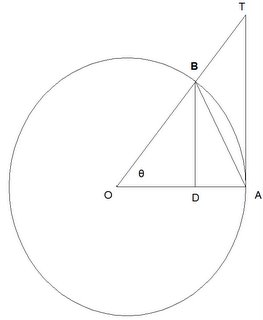
Proof:
(1) Let r be the length of the radius of circle O.
(2) The area for triangle OAB = (1/2)r*(r*sin θ) [See here for details if needed]
= (1/2)r2*sin(θ)
(3) The area of the sector OAB = (1/2)r2θ [Proof to be added later]
(4) The area of the triangle OAT = (1/2)r2tan(θ)
[Since the area of a triangle is (1/2)base*height, see here if needed, with base = r and height = r*tan(θ), see here if needed]
Now, since tan(θ) = sin(θ)/cos(θ) [see here if needed], then we have:
The area of triangle OAT = (1/2)r2(sin θ)/(cos θ)
(5) So, we can see that:
area of triangle OAB is less than area of the sector OAB which is less than area of the triangle OAT.
So that:
(1/2)r2(sin θ) is less than (1/2)r2θ which is less than (1/2)r2(sin θ)/(cos θ)
(6) Dividing all sides by (1/2)r2 gives us:
sin θ is less than θ which is less than sin(θ)/cos(θ)
(7) Now, if we divide (5) by sin θ (assuming sin θ ≠ 0), then we get:
1 is less than θ/(sin θ) which is less than 1/cos(θ)
Taking the reciprocal for each value gives us:
1 is greater than (sin θ/θ) which is greater than cos(θ).
(8) Now, we know that the limit (θ → 0) 1 = 1, by the Constant Law (see here).
(9) We know that lim(θ → 0) cos(θ) = 1 since:
(a) cos θ is a continuous function (see here if more details are needed)
(b) so this means lim (θ → 0) cos θ = cos 0 = 1 (see here for definition of continuous functions, see here for review of why cos 0 = 1)
(10) But now, we can apply the Squeeze Rule (see here), to get:
lim (θ → 0) (sin θ/θ) = 1.
QED
To be clear, I am using Euclidean Geometry to determine the derivative for sin x and cosine x, then I am using the Taylor Series to show that these results are equivalent to an infinite series that makes no such assumption. These ideas form the foundation of Euler's Identity which is one of the most amazing results in all of mathematics.
Lemma 1: if (a/b) is greater than (c/d), then d/c is greater than b/a
Proof:
(1) Let n be a positive value such that 10n that is greater than (a/b).
(2) 10n / (c/d) is greater than 10n/(a/b) since any number can be divided more times by a smaller amount.
(3) But now, if we divide both sides of the equation by 10n, we get:
1/(c/d) is greater than 1/(a/b)
which means that:
d/c is greater than b/a
QED
Lemma 2: lim(θ → 0) sin θ/θ = 1
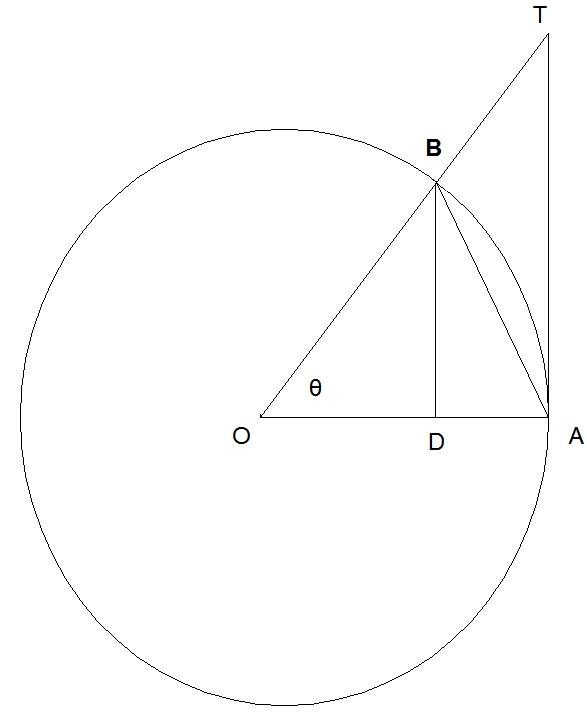
Proof:
(1) Let r be the length of the radius of circle O.
(2) The area for triangle OAB = (1/2)r*(r*sin θ) [See here for details if needed]
= (1/2)r2*sin(θ)
(3) The area of the sector OAB = (1/2)r2θ [Proof to be added later]
(4) The area of the triangle OAT = (1/2)r2tan(θ)
[Since the area of a triangle is (1/2)base*height, see here if needed, with base = r and height = r*tan(θ), see here if needed]
Now, since tan(θ) = sin(θ)/cos(θ) [see here if needed], then we have:
The area of triangle OAT = (1/2)r2(sin θ)/(cos θ)
(5) So, we can see that:
area of triangle OAB is less than area of the sector OAB which is less than area of the triangle OAT.
So that:
(1/2)r2(sin θ) is less than (1/2)r2θ which is less than (1/2)r2(sin θ)/(cos θ)
(6) Dividing all sides by (1/2)r2 gives us:
sin θ is less than θ which is less than sin(θ)/cos(θ)
(7) Now, if we divide (5) by sin θ (assuming sin θ ≠ 0), then we get:
1 is less than θ/(sin θ) which is less than 1/cos(θ)
Taking the reciprocal for each value gives us:
1 is greater than (sin θ/θ) which is greater than cos(θ).
(8) Now, we know that the limit (θ → 0) 1 = 1, by the Constant Law (see here).
(9) We know that lim(θ → 0) cos(θ) = 1 since:
(a) cos θ is a continuous function (see here if more details are needed)
(b) so this means lim (θ → 0) cos θ = cos 0 = 1 (see here for definition of continuous functions, see here for review of why cos 0 = 1)
(10) But now, we can apply the Squeeze Rule (see here), to get:
lim (θ → 0) (sin θ/θ) = 1.
QED
Subscribe to:
Posts
(
Atom
)